


27 Apr ESS Syllabus Explained: Your Guide to IB ESS Success
TL;DR:
- ESS uniquely combines science and social studies, emphasizing critical thinking and real-world application.
- The syllabus is updated for 2024/2026, introducing Higher Level and emphasizing application skills.
- Success depends on understanding command terms, data analysis, systems thinking, and strategic exam preparation.
Many IB students assume Environmental Systems and Societies is simply another science course with memorization and lab reports. It’s not. ESS is one of the most unique subjects in the IB Diploma Programme, sitting at the crossroads of science and social studies, asking you to think about ecosystems, human behavior, ethics, and policy all at once. And right now, the syllabus is changing in ways that directly affect how you study and how you’re examined. This guide walks you through the full ESS structure, the 2024/2026 updates, core topics, assessment breakdown, and practical strategies to help you earn the grade you’re aiming for.
Table of Contents
- What is ESS? Overview and curriculum structure
- Major syllabus updates: 2024/2026 changes and what they mean
- Core topics and HL extensions: What you’ll study in ESS
- Assessment and exam structure: Your roadmap to scoring high in ESS
- What most students (and teachers) miss about the ESS syllabus
- Get expert help to master the ESS syllabus
- Frequently asked questions
Key Takeaways
| Point | Details |
|---|---|
| ESS bridges science and society | ESS integrates scientific analysis with social perspectives, helping IB students develop holistic understanding. |
| 2024/2026 syllabus changes matter | Recent updates affect how students learn, study, and prepare for exams, introducing HL for deeper study. |
| Master core topics and HL extensions | Focusing on the eight core topics and HL lenses ensures comprehensive academic preparation. |
| Assessment relies on evidence and structure | Success requires command of key exam skills like PEEL structure and real-world application. |
| Real-world thinking beats memorization | Students who engage critically with systems and sustainability outperform rote learners. |
What is ESS? Overview and curriculum structure
Now that you know why understanding the syllabus is crucial, let’s clarify what ESS actually is and how it’s structured within the IB.
ESS stands for Environmental Systems and Societies, an interdisciplinary IB Diploma Programme course combining the sciences and individuals/societies subject groups. That dual classification is important. It means ESS counts toward both your science requirement and your individuals/societies requirement, depending on your Diploma setup. For many students, this makes ESS a smart and strategic subject choice.
What makes ESS genuinely different from other sciences is its interdisciplinary nature. You’re not just studying ecosystems in isolation. You’re exploring how human decisions, cultural values, and economic systems shape the environment, and how environmental changes feed back into society. This is a course that asks you to think critically about cause and effect at a global scale.
Here’s what that looks like in practice. You might study a deforested region in Brazil and be asked to assess it through the lens of biodiversity loss, local community displacement, international trade policy, and climate change all in a single essay response. That kind of thinking is exactly what ESS is designed to build.
The course develops several key skills that are directly tested in your exams:
- Systems thinking: Understanding how components of an ecosystem interact and influence each other
- Sustainability analysis: Evaluating whether human activities can continue long-term without depleting resources
- Evaluation of perspectives: Recognizing that environmental issues are shaped by political, cultural, and economic viewpoints
- Data interpretation: Reading and analyzing graphs, diagrams, and case studies under timed exam conditions
- Research and investigation: Designing and completing your own scientific inquiry for the Internal Assessment
“ESS is not a ‘soft science.’ It demands rigorous thinking, real-world application, and the ability to hold multiple perspectives at once. Students who approach it that way consistently perform better.”
The benefits for IB students choosing ESS go beyond academics. The skills you build in this course, especially the ability to analyze complex systems and support arguments with evidence, are highly valued in university programs ranging from environmental policy and law to business sustainability and public health. If you’re looking for a complete guide to success in ESS, starting with a clear understanding of the course structure is the right first step.
Major syllabus updates: 2024/2026 changes and what they mean
With ESS defined, let’s examine the biggest updates in the syllabus that shape how current students study and prepare.
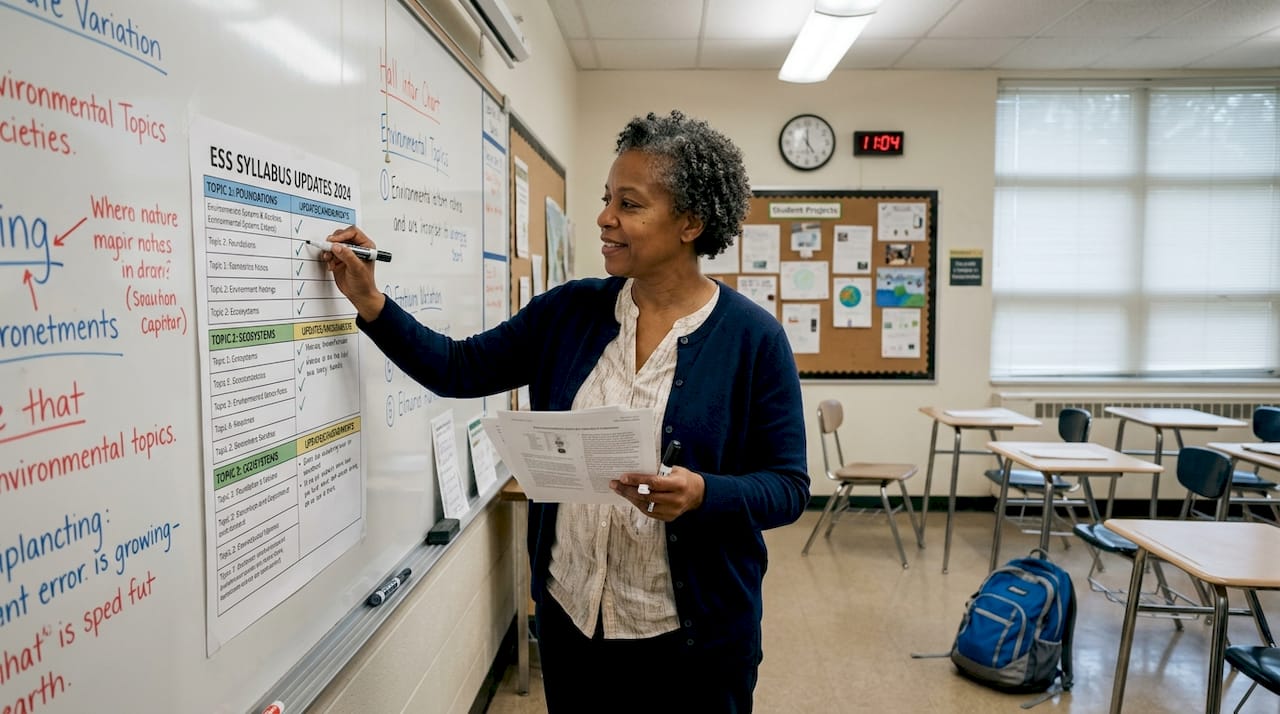
The most significant change in recent IB history for this subject is the introduction of Higher Level (HL). Previously, ESS was offered only at Standard Level (SL). The syllabus was updated for first teaching August 2024, first assessments May 2026, and ESS is now offered at both SL (150 hours) and HL (240 hours). This is a major structural shift that opens new academic pathways for students interested in environmental science, sustainability policy, and related university courses.
Here’s a quick comparison of SL and HL to help you understand the key differences:
| Feature | SL | HL |
|---|---|---|
| Teaching hours | 150 hours | 240 hours |
| External exam weighting | 75% | 80% |
| Paper 1 | 1 hour, 35 marks (case study) | 2 hours, 70 marks |
| Paper 2 | 2 hours, 60 marks | 2.5 hours, 80 marks |
| IA weighting | 25% | 20% |
| HL extensions | None | Law, economics, ethics |
| First assessment | May 2026 | May 2026 |
The introduction of HL also means that the assessment structure has been updated to reflect deeper content demands. If you’re currently studying under the new syllabus, it’s worth consulting the official subject brief to understand exactly what’s expected at your level.
Key updates that affect your exam preparation include:
- New HL pathway: If you’re taking HL, you cover an additional 90 hours of content, including three specialized lenses: environmental law, environmental and ecological economics, and environmental ethics
- Revised assessment weightings: Both SL and HL have updated paper structures and mark distributions compared to the previous syllabus
- Greater emphasis on application: The new syllabus places more weight on applying environmental concepts to real-world scenarios rather than simply recalling facts
- Updated case study requirements: Paper 1 at SL is now specifically a case study paper, requiring you to analyze unseen material under exam conditions
Students who began studying ESS before August 2024 are working under a transitional period. Make sure you know which syllabus version applies to your year group, because exam questions, paper formats, and assessment criteria differ between the old and new versions. Our ESS study tips go deeper on how to adjust your revision for whichever version applies to you.
Core topics and HL extensions: What you’ll study in ESS
Understanding the structural changes helps inform what you’ll actually study. Here’s a breakdown of core and HL ESS syllabus topics.
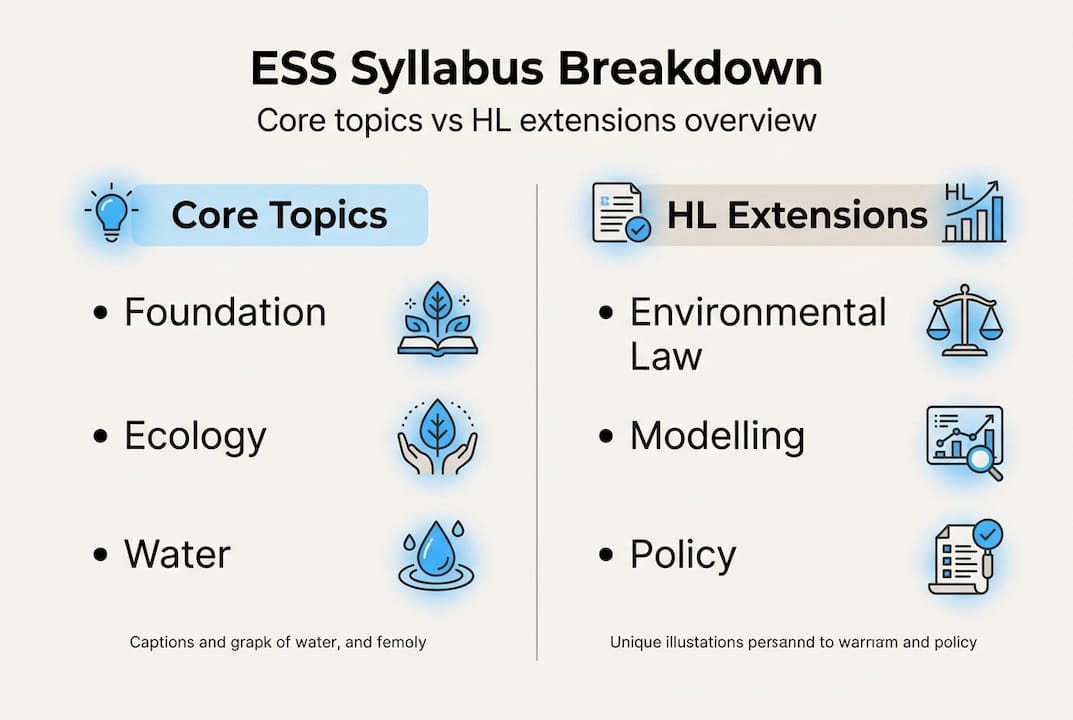
The core syllabus is organized around 8 topics: Foundation, Ecology, Biodiversity and Conservation, Water, Land, Atmosphere and Climate Change, Natural Resources, and Human Populations and Urban Systems. These eight areas form the backbone of everything you’ll be tested on at both SL and HL.
Here’s how each topic connects to real-world environmental issues:
- Foundation: Systems thinking, ecological footprint, environmental value systems. This topic gives you the conceptual toolkit for the rest of the course.
- Ecology: Ecosystems, energy flow, nutrient cycles, population dynamics. You’ll analyze food webs and carrying capacity in exam questions.
- Biodiversity and conservation: Species diversity, extinction, protected areas, conservation strategies. Highly relevant to Paper 2 essays.
- Water: Freshwater systems, pollution, water management, access and equity. Often examined through data analysis tasks.
- Land: Soil degradation, agriculture, land use change, food security. Connects strongly to sustainability and human impact themes.
- Atmosphere and climate change: Climate science, greenhouse gases, feedback loops, international agreements. One of the most heavily examined topics.
- Natural resources: Energy types, resource depletion, pollution, waste management. Important for both case studies and extended writing.
- Human populations and urban systems: Demographic models, urbanization, ecological footprints of cities. Ties directly to the “societies” dimension of ESS.
| Topic | Estimated SL weighting | Key exam skills |
|---|---|---|
| Foundation | High (underpins all other topics) | Defining systems, evaluating perspectives |
| Ecology and Biodiversity | High | Data analysis, comparison tasks |
| Atmosphere and Climate | High | Essay writing, evidence evaluation |
| Human Populations | Medium | Graphical interpretation, case analysis |
For HL students, three extension lenses deepen your engagement with these topics. The three HL lenses are environmental law, environmental and ecological economics, and environmental ethics. These aren’t separate topics you study in isolation. They’re applied to the eight core areas, asking you to analyze an ecosystem collapse through legal frameworks, economic valuation models, or ethical responsibility arguments.
The unifying concepts running through the entire course are perspectives, systems, and sustainability. Every topic, every essay, and every data task in ESS connects back to at least one of these three ideas. Keeping them in mind as you study makes your answers stronger and more cohesive.
Pro Tip: Use the IB ESS topic guide to check which topics appear most frequently in past papers. Prioritizing high-frequency topics in your revision can give you a measurable edge on exam day. Also, if you’re planning your IA, exploring IA survey topics early can help you choose a research question that genuinely interests you, which makes the writing process much easier.
Assessment and exam structure: Your roadmap to scoring high in ESS
With the topics and structure clear, it’s time to tackle how you’re actually assessed and what top students do to succeed.
Understanding the assessment model for ESS is essential for exam success. Here’s the full breakdown. SL Assessment: External 75% (Paper 1: 25%, 1 hour, 35 marks, case study; Paper 2: 50%, 2 hours, 60 marks), IA 25%. HL: External 80% (Paper 1: 30%, 2 hours, 70 marks; Paper 2: 50%, 2.5 hours, 80 marks), IA 20%.
Your Internal Assessment is an individual scientific investigation of up to 3000 words focused on an ESS research question. This is your chance to demonstrate real scientific inquiry skills. The best IAs show a clear methodology, honest analysis of results, and a strong connection between your findings and broader ESS concepts like sustainability or biodiversity. You can look at internal assessment examples to understand the standard expected, and browse IA ideas for ESS to find a topic that fits your interests and access to data.
For the external exams, here are the most effective strategies that high-scoring ESS students consistently use:
- Master command terms: Words like evaluate, discuss, explain, and compare each require a different type of response. If you misread a command term, you can lose marks even when your content is correct.
- Use the PEEL structure: Point, Evidence, Explanation, Link. This structure keeps your essay answers focused and ensures you’re always backing up your claims with specific examples or data.
- Practice data analysis: Both papers include data-based questions. Practice reading graphs, tables, and maps quickly and accurately. The question is usually testing your ability to draw conclusions from data, not just describe what you see.
- Apply real-world examples: Examiners reward responses that use specific, real examples. Reference actual case studies like the Amazon deforestation, the Aral Sea, or the Paris Agreement rather than speaking only in general terms.
- Avoid over-memorizing definitions: ESS exams reward thinking and application far more than definition recall. Knowing how an ecosystem functions under stress is more valuable than memorizing a textbook definition.
- Time your papers in practice: With limited time in each paper, especially at HL, practicing under timed conditions regularly is critical. This builds the habit of writing concise, structured responses quickly.
Pro Tip: Before your exam, review your ESS exam strategies thoroughly. Many students underperform not because of content gaps but because they haven’t practiced the specific skills the exam is designed to assess.
What most students (and teachers) miss about the ESS syllabus
These strategies and assessments are important, but here’s what students really need to know about thriving with the ESS syllabus.
The biggest mistake I see students make is treating ESS like a content course. They create long notes, memorize definitions of species diversity or ecological footprint, and hope those facts carry them through the exam. They don’t. ESS exams are designed to assess thinking, not storage.
Success in ESS comes from command terms, PEEL structure, data analysis, and avoiding memorization. Prior to 2024, ESS was SL only. The new HL pathway now enables students to pursue deeper university preparation in environmental science and policy. That’s genuinely exciting, but only if you approach HL strategically. Choosing HL because it seems easier than Biology or Chemistry is not a good reason. Choosing it because you want to go deep on environmental ethics, law, or economics and you’re willing to put in the extra hours is exactly the right reason.
Teachers sometimes underestimate how much explicit exam skill training ESS students need. Good content teaching is not enough. Students need deliberate practice with past papers, feedback on command term responses, and real guidance on how to structure arguments. That’s where evidence-based ESS strategies and knowing what to expect in an ESS class can make a real difference for your performance.
Systems thinking is your greatest asset in this course. Once you genuinely understand how components of a system interact, every new topic starts to feel familiar because the logic repeats.
Get expert help to master the ESS syllabus
Now that you’ve got the expert perspective, here are ways to access guidance and maximize your exam results.
If you’re feeling uncertain about any part of the ESS syllabus, you’re not alone. The interdisciplinary structure, the new HL pathway, and the updated assessment format are a lot to navigate on your own. That’s exactly why personalized support matters. Whether you need help understanding the ESS course overview, refining your approach using proven ESS exam strategies, or improving your IA by studying strong ESS internal assessment examples, there are structured resources ready to support you.
At esstutor.net, I work with IB ESS students worldwide, helping them build the specific skills examiners look for. With over 13 years of experience as an IB examiner and educator, I know exactly what separates a 5 from a 7 in this subject. Book a trial lesson and let’s build your confidence together.
Frequently asked questions
What are the eight core topics in the ESS syllabus?
The eight core topics are Foundation, Ecology, Biodiversity and Conservation, Water, Land, Atmosphere and Climate Change, Natural Resources, and Human Populations and Urban Systems.
What is the main difference between SL and HL in ESS?
SL covers 150 hours with a broad foundation, while HL includes 240 hours and three advanced extension lenses covering law, economics, and ethics.
How is the ESS Internal Assessment structured?
The IA is an individual scientific investigation of up to 3000 words, focused on a self-selected ESS research question, and it counts for 25% of your final grade at SL.
What assessment model does ESS use for SL and HL?
SL uses 75% external exams and 25% IA, while HL shifts to 80% external exams and 20% IA, with different paper formats and mark distributions at each level.
What skills are most important for ESS exam success?
Understanding command terms, applying the PEEL structure, interpreting data accurately, and connecting answers to real-world examples are the skills that consistently separate high-scoring students from the rest.
No Comments