


14 Jun Role of Global Issues in ESS: IB Student Guide
TL;DR:
- Global issues are central to the IB ESS curriculum, shaping assessments and fostering systems thinking. Engaging critically with challenges like climate change and biodiversity loss develops analytical and interdisciplinary skills essential for higher-level responses. Connecting local data to global patterns enhances understanding and achieves top exam performance.
Global issues in Environmental Systems and Societies (ESS) are defined as large-scale environmental, social, and political challenges that shape how students analyze ecosystems, human behavior, and sustainability. The role of global issues in ESS goes far beyond background context. These challenges form the structural backbone of the entire IB ESS curriculum, connecting local case studies to worldwide patterns of climate change, biodiversity loss, and resource depletion. Understanding them is not optional. It is the difference between surface-level answers and the kind of nuanced, systems-based thinking that earns top marks.
How global issues shape the ESS curriculum and assessments
The IB ESS curriculum is built around 7 to 8 core topics, each directly tied to a global environmental challenge. Climate change, biodiversity, pollution, and resource management are not standalone units. They are lenses through which students examine how human systems interact with natural ones.
The 2026 curriculum updates push this further. Students are now expected to engage with global data and socio-political complexity, not just scientific definitions. That means reading UNEP reports, analyzing stakeholder conflicts, and evaluating policy responses across different cultural contexts.
Here is what global issues directly influence in your ESS assessments:
- Paper 1 and Paper 2 questions regularly draw on real-world environmental scenarios requiring students to apply systems thinking to global problems
- Internal assessments (IAs) reward students who connect local fieldwork data to broader global trends
- Extended essays in ESS gain depth when framed around a globally significant environmental question
- Higher Level (HL) students face additional expectations around depth of analysis, including evaluating adaptation strategies and multi-stakeholder solutions
Pro Tip: When you write an ESS exam response, name the global issue explicitly in your opening sentence. Examiners reward students who frame their answers within a recognized global context from the start.
The ManageBac 2026 updates confirm a shift away from passive knowledge recall toward active critical engagement. That shift is driven entirely by the complexity of global issues.
What are the primary global challenges covered in ESS?
The four most prominent global challenges in ESS are climate change, land degradation, biodiversity decline, and pollution. Each one carries real data that students must be able to interpret and apply.
| Global Challenge | Scale of Impact | ESS Relevance |
|---|---|---|
| Climate change | Rising global temperatures, sea level increase | Systems thinking, feedback loops, policy analysis |
| Land degradation | 75% of Earth’s land surface significantly altered | Soil systems, food security, human population |
| Biodiversity loss | Wildlife populations down 73% since 1970 | Species diversity, ecosystem services, conservation |
| Pollution | Air, water, and soil contamination across all regions | Pollutant pathways, bioaccumulation, health impacts |
That 73% decline in wildlife populations is not just a statistic to memorize. It signals a collapse in ecosystem services that underpins every food web and human economy on the planet.
Global challenges also carry a local dimension that ESS uses deliberately. A student in Kenya studying land degradation and a student in Canada studying boreal deforestation are analyzing the same global system from different entry points. ESS rewards that comparative thinking.
Here is why these challenges matter for your learning outcomes:
- They require systems thinking, meaning you must trace cause and effect across multiple interacting variables
- They demand stakeholder analysis, since no environmental problem exists without competing human interests
- They build evaluation skills, because global issues rarely have one correct solution
- They connect top environmental issues to the real-world data you need for strong IA and exam responses
How does ESS teach students to analyze global issues?
ESS gives students a specific set of analytical tools for working through global environmental problems. The two most important are systems thinking and environmental value systems (EVS).
Systems thinking means you do not look at climate change as a single cause-and-effect relationship. You map it as a web of feedback loops, tipping points, and cross-system interactions. Incorporating socio-political complexities with scientific data is what separates a Level 5 response from a Level 7 one.
Environmental value systems classify how different stakeholders view the natural world, from ecocentrism to technocentrism. This framework lets you explain why governments, corporations, NGOs, and local communities often reach opposite conclusions about the same environmental data.
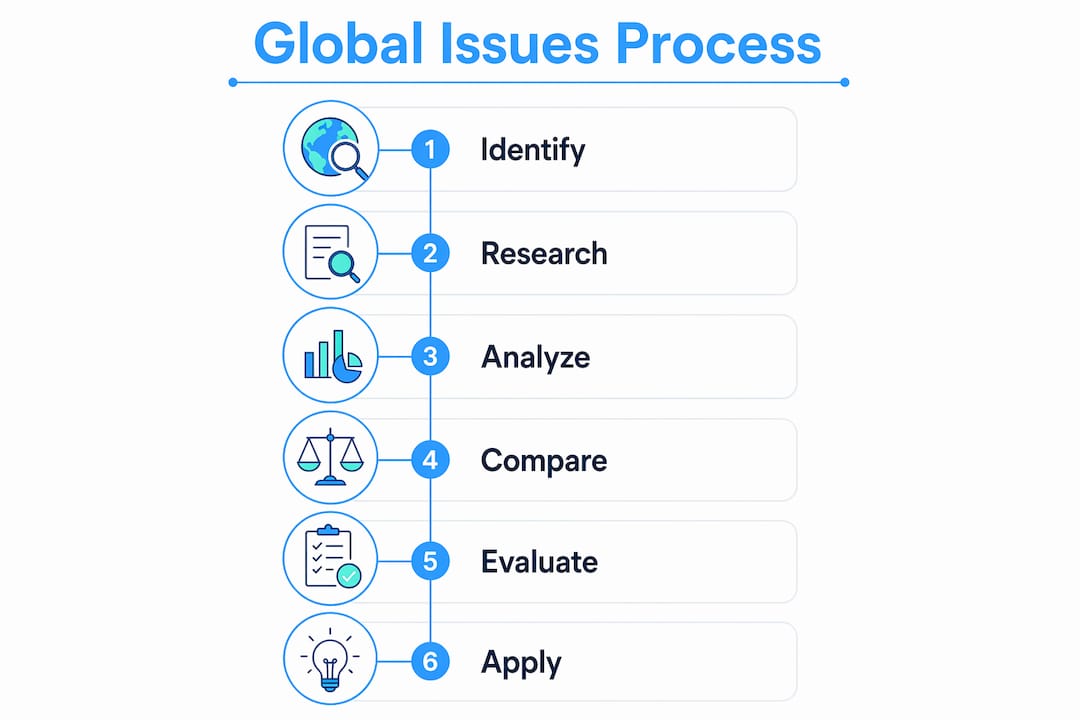
Here is a practical process for analyzing any global issue in ESS:
- Identify the system. Define the boundaries of the ecosystem or human system involved.
- Map the inputs and outputs. What flows into and out of the system? Energy, matter, information?
- Identify feedback loops. Is the system self-regulating, or are human actions disrupting equilibrium?
- Apply stakeholder analysis. Who is affected? What are their values and interests?
- Evaluate solutions. Use EVS to explain why different stakeholders favor different responses.
- Connect to global data. Reference UNEP, UNESCO, or IB case study data to support your argument.
Pro Tip: Practice applying this six-step process to a new global issue every week. By exam time, it becomes automatic. Students who internalize this framework consistently score higher on Paper 2 structured questions.
Effective ESS teaching requires comparing scientific, social, and cultural dimensions together. That is exactly what this process trains you to do.
What is the impact of global issues on ESS learning outcomes?
Engaging with global issues in ESS builds three skills that go well beyond the exam room: critical thinking, interdisciplinary reasoning, and global citizenship.
Critical thinking develops when students work with real UNEP and UNESCO data rather than textbook summaries. The numbers force you to ask harder questions. UNESCO’s education foresight stresses preparing students for accelerated global change by integrating environmental and social dimensions into learning. That is exactly what ESS does.
“Education must look ahead to global environmental and socio-political trends to prepare learners effectively.” — UNESCO Global Education Monitoring Report
The socio-economic stakes are real. 273 million children were out of school in 2024, with environmental crises among the contributing factors. That figure gives ESS students a direct reason to care about the connection between environmental stability and educational equity.
Interdisciplinary reasoning grows when you stop treating biology, economics, and politics as separate subjects. ESS requires you to hold all three simultaneously. A student analyzing plastic pollution must understand polymer chemistry, supply chain economics, and international treaty law at the same time.
Local examples combined with global case studies enhance student engagement and promote deeper systems thinking. This is why Esstutor always encourages students to ground their IAs in a local context before scaling up to the global picture. It makes the analysis more credible and more personally meaningful.
Understanding sustainability concepts within ESS also prepares you for careers in environmental policy, conservation science, urban planning, and international development. The skills you build here are genuinely transferable.
Key takeaways
Global issues are the core organizing principle of IB ESS, and students who engage with them analytically rather than descriptively consistently achieve higher scores.
| Point | Details |
|---|---|
| Curriculum is built on global challenges | Climate change, biodiversity, pollution, and resource management anchor every ESS topic. |
| Systems thinking is non-negotiable | Students must map feedback loops and cross-system interactions, not just define terms. |
| Stakeholder analysis drives evaluation | EVS frameworks explain why different groups reach opposite conclusions from the same data. |
| Local-global comparison builds depth | Connecting fieldwork data to global trends strengthens both IAs and exam responses. |
| Future readiness is a core outcome | ESS builds critical thinking and interdisciplinary skills directly applicable beyond the IB. |
What i’ve learned teaching global issues in ESS
After more than 13 years working with IB ESS students as both a tutor and examiner, I have noticed one pattern more than any other. Students who struggle with global issues in ESS are almost always trying to memorize them rather than analyze them.
Climate change is not a fact to recall. It is a system to interrogate. When a student asks me why their Paper 2 response scored a 4 instead of a 7, the answer is usually the same. They described the issue. They did not evaluate it.
The students who perform best are the ones who get genuinely curious about the data. When you read that wildlife populations have declined 73% since 1970, the right response is not to write it down. The right response is to ask: which systems caused this, who benefits from the status quo, and what would a genuine solution require?
I also think teachers and students underestimate how much the local-global connection matters emotionally, not just academically. When a student in the Philippines connects typhoon frequency to global sea surface temperature data, the issue stops being abstract. That emotional engagement is what drives the kind of sustained analysis that examiners reward.
My honest advice: spend less time on definitions and more time on environmental policies and stakeholder conflicts. That is where the marks live.
— Marija
Ready to master ESS global issues with expert support?
If you want to move from describing global issues to actually analyzing them at a Level 7 standard, personalized tutoring makes a real difference. Esstutor offers one-on-one online sessions with an experienced IB examiner who knows exactly what the curriculum requires in 2026.
Whether you are working through your IA, preparing for Paper 2, or trying to understand how systems thinking applies to real exam questions, Esstutor builds sessions around your specific gaps. Start with a full overview of the IB ESS course to see how global issues connect across every topic. You can also explore proven exam strategies that align directly with the 2026 assessment objectives. Book a trial lesson and see the difference focused, examiner-led preparation makes.
FAQ
What is the role of global issues in ESS?
Global issues in ESS define the curriculum’s core topics and assessment objectives. They give students the real-world context needed to apply systems thinking, stakeholder analysis, and environmental value systems.
How do global issues affect ESS exam performance?
Students who analyze global issues using frameworks like EVS and systems thinking consistently score higher than those who only describe them. Paper 2 questions are specifically designed to reward evaluative, multi-perspective responses.
Which global issues are most important for IB ESS in 2026?
Climate change, biodiversity loss, land degradation, and pollution are the four most prominent challenges. The IB ESS curriculum integrates all four across multiple topics and assessment tasks.
How does ESS connect local examples to global challenges?
ESS uses comparative case studies to link local fieldwork data to global patterns. ManageBac confirms that local-global comparisons deepen systems thinking and critical analysis skills.
Does understanding global issues help with the ESS internal assessment?
Yes. IAs that connect local data to a recognized global environmental challenge demonstrate stronger analytical depth. Examiners reward students who situate their fieldwork within a broader context of global significance.
No Comments