


05 Jul Step by Step IA Preparation: Your IB ESS Guide
TL;DR:
- Following a structured, phased approach helps students consistently meet IB ESS rubric criteria and produce high-quality internal assessments.
- Key prerequisites include understanding the rubric, selecting a focused topic early, and planning data collection methods thoroughly.
Step-by-step IA preparation is a systematic process that breaks your IB Environmental Systems and Societies Internal Assessment into focused, manageable phases aligned with IB rubric criteria and examiner expectations. Students who follow a structured IA preparation guide consistently outperform those who write without a plan, because the IB ESS rubric rewards deliberate, evidence-based decision-making at every stage. The IB ESS internal assessment requires you to demonstrate personal engagement, replicable methodology, and thorough evaluation. Skipping any phase creates gaps that examiners notice immediately. This guide walks you through every step, from topic approval to final submission, so you know exactly what to do and when.
What prerequisites and tools do you need before starting your IA?
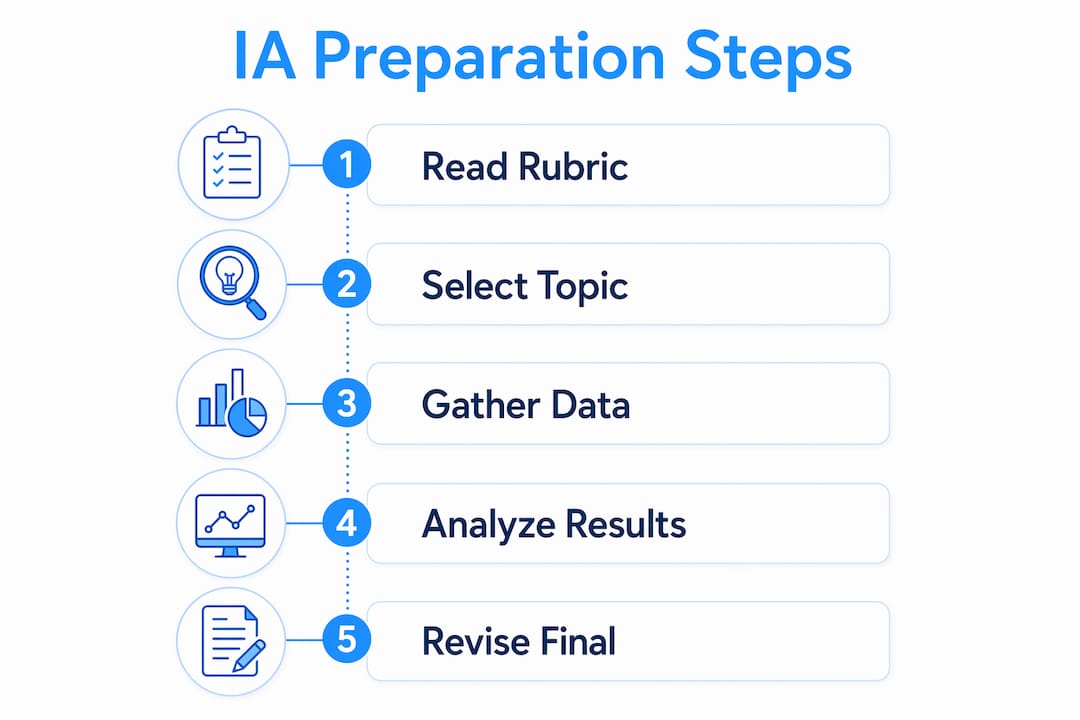
Strong IA preparation starts before you write a single word. The most important first action is reading the IB ESS IA rubric three times. Reading the rubric three times transforms abstract criteria into a concrete evidence checklist. Your first read builds general understanding. Your second read identifies the action verbs, words like “justify,” “evaluate,” and “reflect,” each of which signals a specific type of evidence you must produce. Your third read turns those verbs into a paragraph-by-paragraph checklist you use throughout drafting.

Topic selection and teacher approval come next. Your topic must be focused enough to investigate within the word limit and broad enough to generate meaningful data. A weak topic, such as “pollution in general,” produces vague results. A strong topic, such as measuring dissolved oxygen levels across three sites in a local river affected by agricultural runoff, gives you a clear research question and a replicable method. Work with your teacher early to get approval, because changing your topic after data collection wastes weeks.
The table below summarizes the key prerequisites and tools you need before beginning your IA project.
| Requirement | Tool or Action |
|---|---|
| Rubric understanding | Read the IB ESS IA rubric three times; build an evidence checklist |
| Topic approval | Discuss with your teacher; confirm focus and feasibility |
| Research question | Draft a specific, testable question tied to an ESS concept |
| Data collection tools | Field equipment, spreadsheet software (e.g., Google Sheets or Excel), or secondary databases |
| Citation management | Use a consistent referencing format such as MLA or APA from day one |
| Ethics and safety | Complete any required school ethics forms before fieldwork begins |
Pro Tip: Map each rubric verb to a specific piece of evidence you plan to collect. Write “justify: explain why I chose this site over alternatives” directly in your planning document. This keeps your decisions visible and earns marks for personal engagement.
How do you conduct your IA research and data collection systematically?
The research and data collection phase runs for 4–6 weeks and is the backbone of your entire IA. Rushing this phase produces thin data that cannot support a strong evaluation. Plan your timeline before you begin collecting anything.
Follow these steps to keep your data collection organized and credible:
- Design your method for replication. Write your methodology so that another student could repeat your experiment exactly. Specify sample sizes, measurement intervals, equipment calibration, and site selection criteria.
- Run a pilot test first. Collect a small preliminary dataset before your full data run. A pilot test reveals equipment problems, unclear variables, and logistical issues you can fix before they cost you time.
- Refine your variables. After the pilot, confirm your independent, dependent, and controlled variables are clearly defined. Vague variables produce data that examiners cannot evaluate.
- Record raw data immediately. Write measurements directly into a labeled data table during collection. Never rely on memory or loose notes. Include units, uncertainty values, and any anomalies you observe.
- Document your decisions. Examiners value visible decision-making throughout the IA, not just at the end. Note why you adjusted a method, why you excluded an outlier, or why you chose one site over another.
- Check ethical compliance. If your investigation involves living organisms, human subjects, or sensitive ecosystems, confirm you have followed your school’s ethics guidelines before proceeding.
Pro Tip: Keep a short field journal alongside your data tables. Write two or three sentences after each data collection session describing what went well and what you changed. This journal becomes your personal engagement evidence when you write your evaluation.
How do you analyze your data and write your IA effectively?
Data analysis and writing run together for 4–6 weeks and account for the majority of your final mark. The IB ESS IA requires clear research questions, processed data, and thorough evaluation within a focused 6–12 page structure. Every page must earn its place.
Start by processing your raw data using appropriate statistical and graphical tools. Calculate means, standard deviations, or percentage change where relevant. Present data in clearly labeled graphs and tables, and choose graph types that match your data. A bar chart works for categorical comparisons. A scatter plot with a line of best fit works for continuous variables showing a trend. Label axes, include units, and write a caption for every figure.
The writing structure matters as much as the data itself. Use the rubric criteria as your paragraph blueprint. The best IA drafts treat each paragraph as a micro-claim: present evidence, analyze it, and evaluate it against your research question. Do not describe what you see in a graph. Explain what it means and why it matters.
Avoid these common writing pitfalls:
- Overextending your word count. The IB ESS IA has a recommended length. Padding with background information that does not connect to your research question wastes space and dilutes your analysis.
- Ignoring the evaluation criteria. Many students write strong methods and data sections but produce a weak evaluation. Address the reliability of your data, the limitations of your method, and specific improvements you would make.
- Vague conclusions. Your conclusion must directly answer your research question with reference to your processed data. “The results showed a trend” is not a conclusion. “Dissolved oxygen decreased by 34% between Site 1 and Site 3, consistent with increased nutrient loading from agricultural runoff” is.
- Missing links to ESS concepts. Connect your findings to relevant ESS topics such as species diversity, ecological footprint, or biogeochemical cycles. Examiners expect you to situate your investigation within the broader subject.
“The rubric is best used as a blueprint. Successful students plan evidence and arguments per criterion from day one, mapping every paragraph to a specific examiner expectation before they write a single sentence.” — IB DP Subject Mastery: IA Optimisation
For more detail on structuring your writing to meet each criterion, the tips for writing high-scoring IAs from Esstutor give you criterion-specific examples.
How do you incorporate feedback, revise, and finalize your IA?
The revision cycle runs for 3–4 weeks and is where most students either gain or lose marks. Teacher feedback is not optional. It is the most direct signal you will receive about rubric gaps before your work goes to an external moderator.
Follow these steps to make the most of your revision cycle:
- Submit a complete draft to your teacher. Do not submit a partial draft. Examiners assess the whole IA, and your teacher needs to see the full picture to give useful feedback.
- Map feedback to rubric criteria. When you receive comments, sort them by criterion. If your teacher notes that your evaluation lacks specific improvements, go directly to the evaluation criterion and check what the top band requires.
- Address every gap, not just the easy ones. Students often fix grammar and formatting but ignore deeper issues like weak rationale or missing uncertainty analysis. Fix the hard things first.
- Prepare for authenticity checks. Your school will submit your IA for IB moderation. Maintaining a buffer and internal deadlines for early submission gives your school time to complete authentication without stress.
- Run a final formatting and citation check. Confirm your page count, citation format, appendix labeling, and figure numbering are all consistent. Formatting errors signal carelessness to examiners.
Pro Tip: Build at least one extra week into your revision timeline. Unexpected school commitments, illness, or a second round of teacher feedback are common. Students who plan for one revision cycle often need two.
What are the most common IA mistakes and how do you fix them?
Common last-minute IA errors include weak focus, insufficient data, poor data processing, generic limitations discussion, and formatting mistakes. Knowing these pitfalls in advance lets you avoid them entirely.
Watch for these specific problems throughout your IA process:
- Weak or broad research question. A question like “How does pollution affect biodiversity?” cannot be answered with a single investigation. Narrow it to a specific pollutant, a measurable biodiversity indicator, and a defined location.
- Insufficient data volume. One data collection session rarely produces enough data for meaningful statistical analysis. Plan for at least three repeated trials or multiple sampling sites.
- Poor data processing. Presenting only raw data without calculations, graphs, or statistical analysis does not meet the processing criterion. Show your working and explain your chosen methods.
- Generic limitations section. Writing “human error could have affected results” without specifying which measurements, how large the error might be, and what you would do differently earns no marks. Be specific.
- Superficial personal engagement. Personal engagement is not a paragraph at the end explaining why you care about the environment. It shows up throughout the IA in your documented decisions, method adjustments, and intellectual curiosity.
- Late submission. Missing your school’s internal deadline affects moderation readiness. A disciplined timetable with milestone deadlines prevents this entirely.
- Misusing AI tools. AI should assist with brainstorming and critique only, not generate your written content. An IA written by AI lacks your authentic voice and violates IB academic integrity policies. Use AI to stress-test your arguments, not to write them.
For a deeper look at choosing a focused ESS IA topic, Esstutor has a dedicated guide that walks you through the topic selection process with examiner-informed criteria.
Key Takeaways
Effective IB ESS IA preparation requires reading the rubric as a blueprint, following a phased timeline, and treating every paragraph as a direct response to examiner criteria.
| Point | Details |
|---|---|
| Rubric as blueprint | Read the rubric three times and map each criterion verb to specific evidence before drafting. |
| Phased timeline | Follow a structured schedule: topic approval, research, analysis, revision, and finalization. |
| Visible decision-making | Document method changes and rationale throughout to earn personal engagement marks. |
| Revision cycle | Allow 3–4 weeks for teacher feedback and address rubric gaps before final submission. |
| Responsible AI use | Use AI only for brainstorming and critique; write all content yourself to maintain authenticity. |
What I have learned from years of guiding students through the IA
After working with IB ESS students for over 13 years, the single biggest pattern I see is this: students who treat the rubric as a living document throughout their IA consistently outscore those who consult it only at the start and end. The rubric is not a checklist you tick off once. It is the lens through which every sentence should be written.
The second thing I have learned is that personal engagement is the most misunderstood criterion. Students think it means writing a heartfelt paragraph about why they love the environment. Examiners read it differently. They look for evidence that you made real intellectual decisions. Why did you choose that specific site? Why did you change your method after the pilot? Why did you select that statistical test over another? Document those decisions as you make them, not after the fact.
Time management is where I see the most stress. Students underestimate how long data collection takes, especially when weather, equipment, or access issues arise. Build buffer weeks into your plan from the start. A student who submits a polished IA two weeks before the school deadline is in a far better position than one scrambling the night before.
Finally, on AI: I encourage students to use it as a thinking partner, not a writing partner. Ask AI to challenge your argument, point out logical gaps, or suggest alternative explanations for your data. That is genuinely useful. Asking AI to write your analysis is not. It produces generic, ungrounded text that examiners recognize immediately, and it robs you of the learning that makes the IA worth doing.
— Marija
How Esstutor supports your IB ESS IA preparation
Preparing a strong IB ESS IA takes more than reading a guide. It takes feedback from someone who knows exactly what examiners look for.
Esstutor offers personalized, one-on-one tutoring from an IB examiner with over 13 years of experience in IB ESS. Sessions focus on your specific IA, covering topic selection, methodology design, data analysis, and revision feedback aligned to the current rubric. You can also access ESS notes and resources to support your research and background reading. Whether you are just starting or preparing your final draft, IB ESS IA tutoring gives you the targeted support that turns a good IA into a great one.
FAQ
What is step by step IA preparation for IB ESS?
Step by step IA preparation is a structured process that divides your IB ESS Internal Assessment into five phases: topic selection, research and data collection, analysis and writing, teacher feedback and revision, and final submission. Following this sequence keeps you aligned with IB rubric criteria at every stage.
How long does IB ESS IA preparation take?
The full IA preparation process spans approximately 14–20 weeks, covering topic approval (2–3 weeks), research (4–6 weeks), analysis and writing (4–6 weeks), revision (3–4 weeks), and finalization (1 week).
How do I use the rubric effectively in my IA?
Read the rubric three times: once for general understanding, once to identify action verbs like “evaluate” and “justify,” and once to build a paragraph-by-paragraph evidence checklist. Successful students map every paragraph to a specific rubric criterion before they begin writing.
Can I use AI to help write my IB ESS IA?
AI is a useful tool for brainstorming and critiquing your arguments, but you must write all content yourself. Using AI to generate your IA text violates IB academic integrity policies and produces writing that lacks the authentic voice examiners assess for personal engagement.
What are the most common reasons IB ESS IAs lose marks?
The most common issues are a broad or unfocused research question, insufficient data, weak data processing, a generic limitations section, and superficial personal engagement. Addressing each of these proactively through rubric checks and multiple revision cycles significantly improves your final score.
No Comments