

06 Jun The Role of Education in Sustainability: 2026 Guide
TL;DR:
- Education for Sustainable Development equips learners with essential knowledge, skills, and values to promote environmental and social justice effectively. Globally, integrating sustainability into curricula, teacher training, and policy requires system-wide coordination to produce meaningful climate literacy and action. Teachers, policymakers, and equity considerations are crucial for translating sustainability education into tangible societal and environmental improvements.
Education for Sustainable Development (ESD) is defined by UNESCO as the process of equipping learners with the knowledge, skills, values, and agency to protect the environment and promote social and economic justice. The role of education in sustainability goes far beyond classroom lessons on recycling or carbon footprints. It shapes how entire generations understand ecological systems, make consumption choices, and engage with policy. This guide breaks down the latest frameworks, 2026 research findings, and practical strategies for students, educators, and policymakers who want to understand how sustainability concepts translate into real-world outcomes.
How education frameworks and global initiatives support sustainability goals
The clearest global anchor for sustainability education is SDG Target 4.7, which calls on all countries to integrate Education for Sustainable Development and Global Citizenship Education into curricula, teacher training, and national assessments by 2030. This target is not aspirational language. It is a measurable policy commitment that shapes how ministries of education write syllabi, train teachers, and allocate budgets. Countries that treat it as a checkbox miss the point entirely.
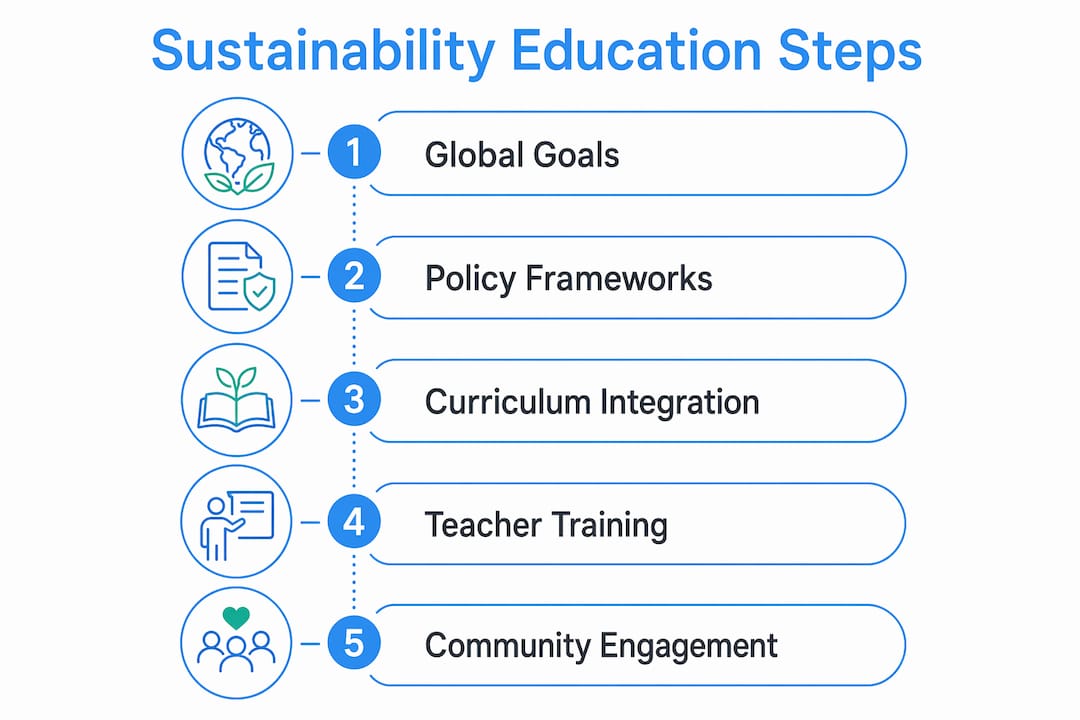
UNESCO’s Greening Education Partnership (GEP) gives that commitment a practical structure. The GEP operates through four system-wide pillars: greening schools, greening curricula, greening teacher training, and strengthening community engagement. Each pillar targets a different layer of the education system, which is exactly why the framework works better than single-subject interventions. A school that installs solar panels but never updates its science curriculum is greening its building, not its students.
The challenge is that most countries are still catching up. A survey of 131 countries found that while most include some environmental content in their curricula, comprehensive climate and biodiversity integration remains limited. That gap matters because surface-level coverage produces surface-level understanding.
The Climate Smart Education Systems Initiative, launched in 2023, addresses this directly. It supports climate-vulnerable countries in mainstreaming climate adaptation into national education plans, strengthening cross-sector collaboration between education and environment ministries, and building teacher capacity at scale. The initiative treats climate education as a systems problem, not a curriculum add-on.
Pro Tip: If you are an IB ESS student or educator reviewing these frameworks, pay attention to how SDG Target 4.7 connects to the IB’s own approaches to environmental literacy. The overlap is significant and directly relevant to your internal assessments and essay arguments.
What does research say about education’s impact on climate literacy?
A 2026 meta-analysis published in Frontiers in Psychology examined school science education’s effect on students’ climate literacy across three dimensions: cognition, attitudes, and behavior. The results are striking and worth understanding carefully.
| Dimension | Effect Size (g) | Interpretation |
|---|---|---|
| Overall climate literacy | 1.01 | Large positive effect from school science education |
| Climate cognition | 1.08 | Strong improvement in factual understanding |
| Climate attitudes | 0.88 | Meaningful shift in values and concern |
| Climate behavior | 0.34 (non-significant) | Weak, unreliable effect on immediate action |
The meta-analysis effect sizes tell a clear story: school science education reliably builds knowledge and shifts attitudes, but it does not reliably produce behavior change on its own. This is not a failure of education. It is a design problem. Programs that expect knowledge gains to automatically produce sustainable behavior are setting themselves up for disappointment.
“Knowledge and attitude gains don’t always yield immediate behavior change. Enabling real-world opportunities is critical.” — Frontiers meta-analysis on climate education, 2026
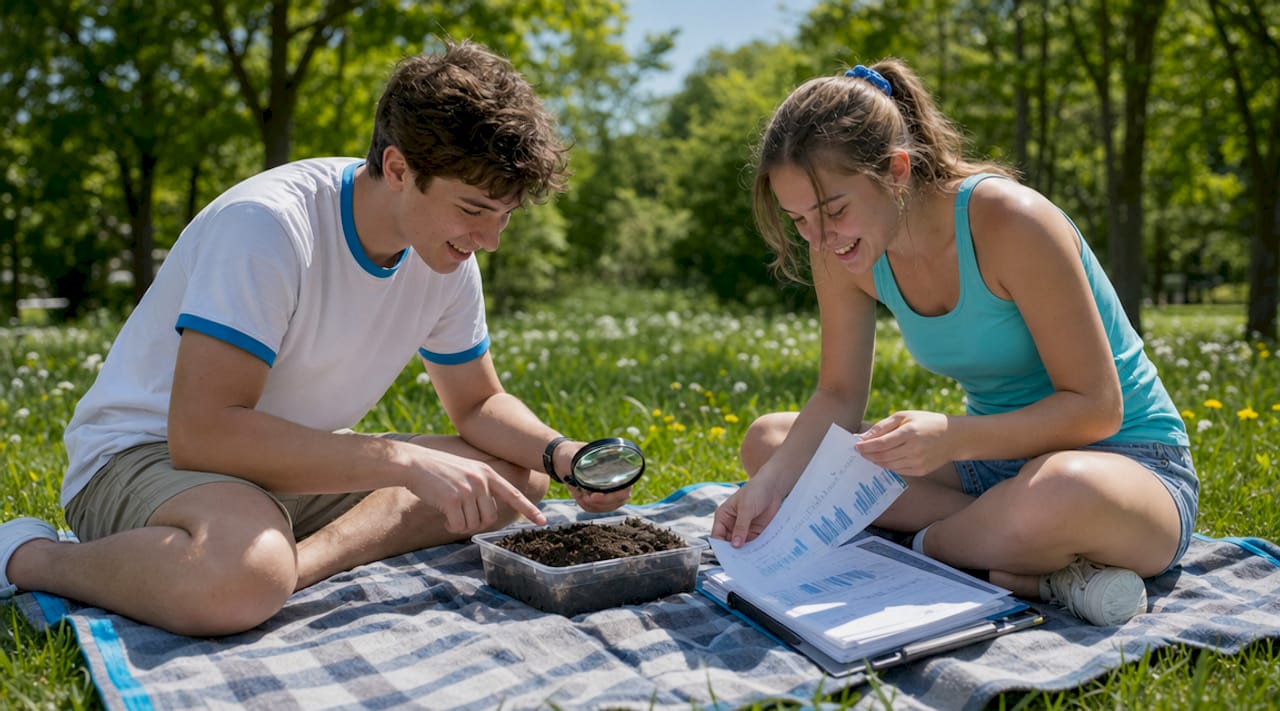
The practical implication is that curriculum interventions need to be paired with enabling conditions. Community projects, school gardens, local environmental monitoring, and student-led campaigns give learners somewhere to direct their improved understanding. Without those outlets, the knowledge sits unused.
Separate cross-country research supports a broader claim: human capital linked to education significantly improves environmental quality and supports renewable energy adoption across multiple national contexts. Higher educational attainment correlates with better environmental outcomes at the population level, even when controlling for income and policy variables. This means investing in education quality is also an environmental policy decision.
What roles do teachers and policymakers play in sustainability education?
Teachers are the most direct point of contact between sustainability policy and student learning. No framework, however well-designed, produces outcomes without educators who understand the material and know how to teach it. UNESCO’s GEP recognizes this through its dedicated pillar on greening teacher training, which targets school leaders, classroom teachers, and policymakers simultaneously.
Effective implementation requires alignment across at least three layers:
- Curricula must explicitly include climate change, biodiversity, ecological footprint analysis, and sustainability ethics, not as optional modules but as core content with assessment weight.
- Teacher training programs must prepare educators to teach these topics with confidence, including pre-service training for new teachers and ongoing professional development for experienced ones.
- Governance structures must connect education ministries with environment and climate ministries so that national sustainability targets actually inform what happens in classrooms.
The most common bottleneck is misalignment between these layers. A country can have excellent sustainability content in its national curriculum while its teacher training colleges ignore the topic entirely. Aligning curricula, teacher training, and governance simultaneously is difficult, but research consistently shows it produces measurably better ESD outcomes than isolated efforts.
Cross-sector coordination is not optional. Mainstreaming climate education requires ministries of education and environment to coordinate plans, budgets, and strategies because sustainability is inherently cross-cutting. When these ministries operate in separate silos, students receive fragmented messages and teachers lack institutional support.
Pro Tip: Policymakers reviewing national education plans should ask one direct question: does our teacher training system prepare educators to teach climate change and biodiversity with the same rigor as mathematics or literature? If the answer is no, that is where reform needs to start.
How does sustainability education address equity and social justice?
Sustainability education is not only about ecological knowledge. At its core, ESD addresses inclusion and human rights to ensure that the transition to a sustainable society does not deepen existing inequalities. UNESCO is explicit on this point: green innovation that benefits only wealthy communities is not sustainable development.
This has direct implications for how sustainability education is designed and delivered:
- Accessibility matters. Sustainability education must reach students in under-resourced schools, rural communities, and low-income households, not just well-funded urban institutions with solar panels and environmental clubs.
- Content must reflect diverse contexts. A curriculum built entirely around temperate forest ecosystems or European policy examples fails students in sub-Saharan Africa, Southeast Asia, or Pacific Island nations who face different and often more urgent environmental pressures.
- Marginalized communities are often most affected. Indigenous communities, low-income populations, and climate-vulnerable regions bear disproportionate environmental burdens. Sustainability education that ignores this reality produces graduates who understand ecology but misunderstand justice.
- Student agency is part of the framework. ESD is not passive information transfer. It builds the capacity for learners to question systems, advocate for change, and participate in governance. That agency is especially important for students from communities with limited political voice.
You can explore how environmental justice principles connect to sustainability education in more depth, particularly if you are working on IB ESS essays or internal assessments that require you to analyze equity dimensions of environmental issues.
Key takeaways
Education for Sustainable Development produces lasting impact only when curricula, teacher training, governance, and community engagement are aligned at the system level rather than treated as separate initiatives.
| Point | Details |
|---|---|
| ESD definition and scope | UNESCO defines ESD as building knowledge, skills, values, and agency for environmental protection and social justice. |
| Knowledge vs. behavior gap | School science education strongly improves climate cognition (g=1.08) and attitudes (g=0.88) but has a weak effect on behavior (g=0.34). |
| System-level alignment | Aligning curricula, teacher training, and governance simultaneously produces better outcomes than isolated classroom projects. |
| Equity is non-negotiable | Sustainability education must explicitly address inclusion and human rights to avoid deepening inequalities through green innovation. |
| Cross-sector coordination | Education and environment ministries must coordinate budgets and strategies to mainstream climate education effectively. |
Why the knowledge-to-action gap is the real challenge
I have worked with IB ESS students for over 13 years, and the pattern I see most often is this: students understand climate change deeply. They can explain feedback loops, calculate ecological footprints, and analyze policy trade-offs with real sophistication. What they struggle with is connecting that knowledge to a sense of personal agency.
The 2026 meta-analysis confirms what I have observed directly. Knowledge gains are real and significant. Attitude shifts happen. But behavior change requires something more than a well-designed lesson. It requires students to see that their understanding can actually change something in the world around them.
The most effective sustainability education I have encountered does not stop at the classroom door. It connects students to local environmental monitoring projects, community planning processes, or school-level sustainability audits where their analysis has a real audience. That is where the gap between cognition and action starts to close.
For policymakers, the lesson is similar. Investing in curriculum reform without investing in teacher capacity and community engagement structures is like building a road with no destination. The infrastructure exists, but nothing moves. The countries making the most progress on ESD are the ones treating it as a whole-system challenge, not a subject to add to an already crowded timetable.
— Marija
Deepen your understanding with Esstutor
If you are an IB ESS student working through sustainability topics for your internal assessment or final exams, having expert guidance makes a measurable difference in both your confidence and your scores.
Esstutor offers personalized, one-on-one tutoring from an IB examiner with over 13 years of experience in Environmental Systems and Societies. Whether you need help structuring your IB ESS internal assessment, working through past papers, or building a stronger grasp of sustainability frameworks for your essays, Esstutor provides targeted support that fits your schedule. You can also access IB ESS notes and study materials to reinforce what you learn in sessions. Book a trial lesson and see the difference expert support makes.
FAQ
What is Education for Sustainable Development?
Education for Sustainable Development (ESD) is UNESCO’s framework for equipping learners with the knowledge, skills, values, and agency to address environmental, social, and economic sustainability challenges. It is a core component of SDG Target 4.7.
Does school education actually change climate behavior?
Research shows school science education strongly improves climate knowledge and attitudes, but a 2026 meta-analysis found the effect on immediate behavior change is weak and statistically non-significant. Behavior change requires enabling conditions like community projects alongside classroom learning.
What is the biggest barrier to effective sustainability education?
The most common barrier is misalignment between curricula, teacher training, and governance. When these three layers are not coordinated, even well-designed sustainability content fails to reach students consistently or produce measurable outcomes.
How does sustainability education connect to social justice?
UNESCO’s ESD framework explicitly integrates human rights and equity, recognizing that green innovation can deepen inequalities if it is not designed to be accessible and inclusive. Sustainability education must address who bears environmental burdens and who benefits from solutions.
How can IB ESS students apply sustainability education concepts?
IB ESS students can apply ESD concepts directly in their internal assessments and extended essays by analyzing how environmental literacy frameworks, policy alignment, and equity considerations shape real-world environmental outcomes in their chosen case studies.
No Comments