


01 May The systems approach: your IB ESS guide for exams
TL;DR:
- A systems approach views environmental issues holistically, emphasizing interconnected components and feedbacks.
- Key system components include inputs, outputs, stocks, flows, transfers, transformations, and feedback loops.
- Effective exam technique involves clear diagrams, boundary identification, and understanding feedbacks and emergent properties.
If you’ve ever felt like environmental problems are just too big and complicated to understand all at once, you’re not alone. Many IB ESS students make the mistake of studying environmental issues piece by piece, only to find they can’t connect the dots in an exam. The systems approach changes that. It gives you a clear, structured way to see how everything fits together, from nutrient cycles to climate change to biodiversity loss. In this guide, we’ll walk through what a systems approach really means, how to apply it in your coursework, and why it’s the key to writing stronger, more holistic exam answers.
Table of Contents
- What is a systems approach?
- Core components of environmental systems
- Types of systems: open, closed, and isolated
- The power of feedback loops and emergent properties
- Applying a systems approach: diagrams, models, and exam skills
- Beyond the textbook: what most IB ESS students miss about the systems approach
- Boost your IB ESS success with expert guidance
- Frequently asked questions
Key Takeaways
| Point | Details |
|---|---|
| Holistic vs reductionist | The systems approach emphasizes seeing the whole, not just parts, which is essential for IB ESS coursework. |
| System components matter | Inputs, outputs, stocks, flows, and feedback loops are the building blocks of environmental analysis. |
| Types of systems | Open, closed, and isolated systems help define boundaries and levels of interaction in IB ESS studies. |
| Feedback drives change | Both negative and positive feedback loops influence stability, sustainability, and exam answers. |
| Diagram and model skills | Drawing diagrams and mapping feedbacks is a top strategy for IB ESS exam success. |
What is a systems approach?
Let’s start with the basics. A systems approach is a method of simplifying and understanding a complicated set of interactions by viewing them holistically rather than reductionistically. In plain terms, it means looking at how all the parts of an environment interact together, not just studying one part in isolation.
This is where holistic vs. reductionist thinking matters a great deal. A reductionist approach breaks things down into individual components and studies each one separately. That sounds logical, but when it comes to environmental issues, it often misses the bigger picture. A holistic approach, on the other hand, focuses on the entire system and how its parts interact. Reductionist vs. holistic thinking shows clearly why IB ESS favors the holistic model, especially for issues like sustainability and ecosystem management.
Here’s why that matters for you:
- Reductionist thinking might study just the fish population in a lake.
- Holistic thinking would consider the fish, the algae, the nutrient inputs from agriculture, the water temperature, and the human communities depending on that lake, all at once.
“A systems approach helps us understand that in nature, everything is connected. Change one part of the system, and ripples move through the entire network.”
Developing this kind of thinking is directly relevant to your key environmental concepts in IB ESS. It also opens up the deeper reasoning you need for Paper 1 and Paper 2 responses. If you’re curious about why this subject takes this approach, exploring the benefits of environmental systems thinking gives you solid context.
Core components of environmental systems
Now that you’ve seen how holistic thinking reframes environmental problems, let’s break down the essential building blocks of systems themselves.
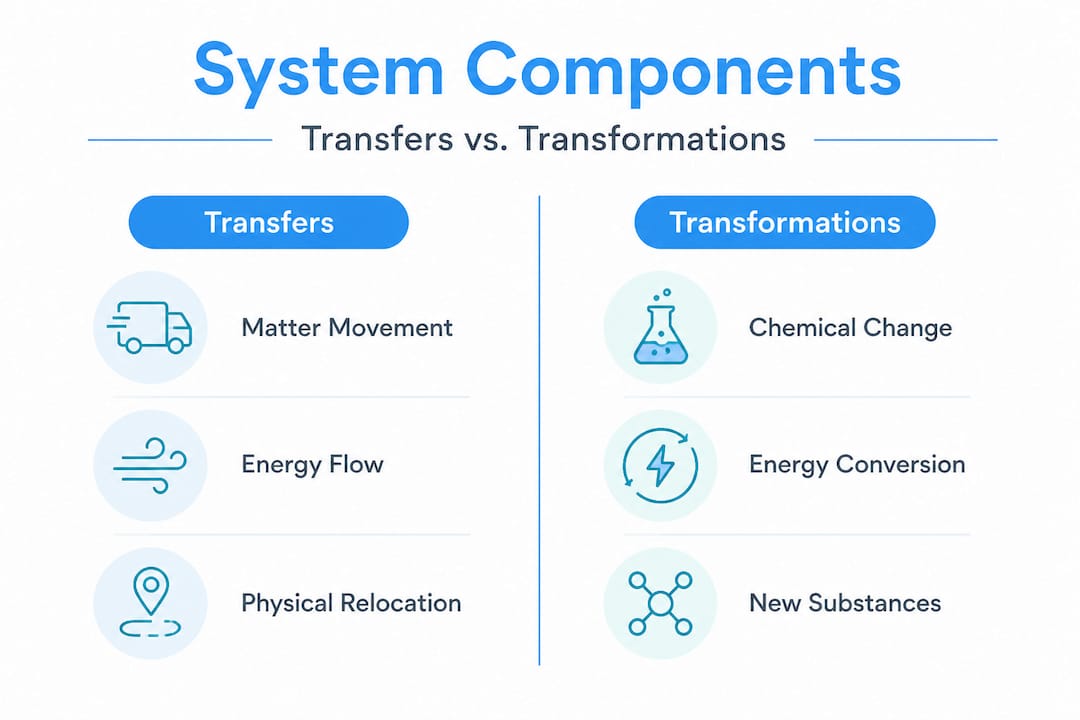
Every environmental system is made up of specific components. Key components include inputs, outputs, storages (also called stocks), flows, transfers, transformations, feedback loops, and emergent properties. You need to know each one clearly because exam questions will often ask you to identify or draw these in a system diagram.
Here’s a quick breakdown of each:
- Inputs: Matter or energy entering the system (e.g., sunlight entering an ecosystem).
- Outputs: Matter or energy leaving the system (e.g., heat lost through respiration).
- Stocks/Storages: The amount of matter or energy held within the system at any given time (e.g., carbon stored in trees).
- Flows: The movement of matter or energy between stocks.
- Transfers: Movement of matter or energy without a change in its form (e.g., water evaporating and moving to clouds).
- Transformations: Movement of matter or energy with a change in form or quality (e.g., photosynthesis converting light energy into chemical energy).
- Feedback loops: Processes where an output circles back to influence the system.
- Emergent properties: Characteristics that arise from the system as a whole, not from any single part.
| Component | Definition | Example |
|---|---|---|
| Input | Matter/energy entering the system | Solar radiation |
| Stock | Amount held in system | Carbon in soil |
| Flow | Movement between stocks | Runoff into rivers |
| Transfer | Movement, no change in form | Water vapor moving to clouds |
| Transformation | Movement with change in form | Photosynthesis |
| Emergent property | New quality from the whole | Ecosystem resilience |
Understanding the difference between transfers and transformations trips up a lot of students. A transfer is simply movement, like a river carrying sediment downstream. A transformation actually changes what something is, like decomposers breaking down organic matter into inorganic nutrients. Both are flows, but they work very differently.
Pro Tip: When you draw a system diagram in an exam, always label whether a flow is a transfer or a transformation. This small detail shows the examiner that you really understand the system, and it can push your mark up.
To build your understanding further, our resources on master IB ESS concepts and systems thinking tips will help you practice applying these components to real scenarios.
Types of systems: open, closed, and isolated
With a clear understanding of system components, it’s important to know the major types of environmental systems and their boundaries.
Systems types fall into three main categories: open, closed, and isolated. Each type is defined by what can cross its boundary.
| System type | Matter exchange | Energy exchange | Example |
|---|---|---|---|
| Open | Yes | Yes | A lake, a forest |
| Closed | No | Yes | Global geochemical cycles |
| Isolated | No | No | Theoretical only |
Here’s how to remember them clearly:
- Open systems exchange both matter and energy with their surroundings. Most ecosystems you study in IB ESS are open systems. A coral reef, for example, receives energy from sunlight and takes in nutrients from ocean currents.
- Closed systems exchange energy but not matter. Global biogeochemical cycles, like the carbon cycle or the nitrogen cycle, are often modeled as closed systems because matter is recycled within them while energy flows through.
- Isolated systems exchange neither matter nor energy. In practice, truly isolated systems don’t exist in nature. They are useful as theoretical models to understand ideal conditions.
Identifying the right system type is about understanding boundaries. When you set up a system diagram or answer an exam question about a specific environmental issue, the first step should always be to identify the system boundary. What is inside? What is outside? What crosses that boundary?
Pro Tip: In IB ESS exams, if a question asks you to “describe the system,” start by stating its type (open, closed, or isolated) and defining its boundary. This immediately signals holistic, structured thinking to the examiner.
Learning to apply these concepts to environmental literacy IB ESS is one of the most useful skills you can build. Understanding how feedback in systems works in practice adds another valuable layer to your analysis.
The power of feedback loops and emergent properties
After understanding system types, let’s dig into what really drives change: feedback loops and emergent properties.

Feedback loops come in two key forms: negative (balancing, stabilizing, e.g., predator-prey cycles) and positive (reinforcing, destabilizing, e.g., the ice-albedo effect). These are not just vocabulary terms. They explain how and why systems change, and they’re central to exam questions about sustainability and environmental change.
Here’s a clear picture of both:
- Negative feedback loops work to stabilize a system. When a predator population increases, prey numbers fall. With less prey available, the predator population then decreases too. This brings the system back toward balance. Negative feedbacks maintain stable equilibrium.
- Positive feedback loops amplify change and can push a system toward a tipping point. The ice-albedo effect is a classic IB ESS example. As ice melts due to warming, more dark ocean surface is exposed. Dark surfaces absorb more heat than reflective ice, causing more warming, which causes more melting. The system accelerates in the same direction.
“Positive feedback loops are particularly important in climate science because they can take a small initial change and turn it into a large, potentially irreversible shift in the system.”
Tipping points are the moments when a system crosses a threshold and moves into a new, often unstable equilibrium. This is where the Gaia hypothesis becomes relevant. The hypothesis suggests that Earth’s biosphere functions like a self-regulating system, using negative feedbacks to maintain conditions suitable for life. However, human pressures can overpower these natural stabilizers, pushing systems past tipping points.
El Niño is another strong example for IB ESS. During an El Niño event, changes in Pacific Ocean temperatures alter atmospheric circulation patterns globally. This is a system responding to positive and negative feedbacks across a massive scale, affecting rainfall, fisheries, and ecosystems worldwide.
Emergent properties arise when a system behaves in ways that none of its individual parts could produce alone. Ecosystem resilience is an emergent property. No single species gives an ecosystem its ability to recover from disturbance. That capacity comes from the interactions of all species and processes working together. For your environmental examples IB ESS, recognizing emergent properties helps you write richer, more complete answers. For evidence-based IB ESS strategies, using feedback loops as evidence of systemic change gives your arguments real depth.
Applying a systems approach: diagrams, models, and exam skills
Having covered the conceptual tools, let’s make it practical with techniques for applying a systems approach to IB ESS coursework and exam questions.
Drawing system diagrams is one of the most tested skills in IB ESS. The ability to identify boundaries, stocks, flows, and feedbacks and represent them visually is something examiners specifically look for in top-scoring responses.
Here’s a step-by-step approach to building a strong system diagram:
- Define the system boundary. Decide what is inside and outside your system. Draw a clear box or circle to represent this.
- Identify the stocks. What are the key stores of matter or energy in your system? Label each one clearly. For a carbon cycle diagram, these might include the atmosphere, oceans, soil, and living biomass.
- Draw the flows. Show how matter or energy moves between stocks. Use arrows. Label each arrow as either a transfer or a transformation.
- Add feedback loops. Indicate where outputs feed back into the system. Use a curved arrow or a loop. Label it as negative or positive feedback.
- Note emergent properties. If relevant to the question, annotate any emergent properties that arise from the system as a whole.
- Check your boundary. Ask yourself: have I shown what enters and exits the system? Is my diagram complete?
Common mistakes to avoid in models and diagrams:
- Forgetting to label the boundary.
- Drawing flows without indicating their direction.
- Confusing transfers with transformations.
- Missing feedback loops entirely.
- Drawing the diagram too vaguely without specific labeled components.
Models are useful tools, but they are simplifications. They can lose accuracy when conditions change rapidly or when positive feedbacks push a system toward unpredictable tipping points. Always acknowledge model limitations in your exam answers. This shows mature, critical thinking.
For more guidance on getting your answers right, our ESS success tips cover exam technique in detail. Our IB ESS guide gives you a clear overview of everything the course expects you to master.
Beyond the textbook: what most IB ESS students miss about the systems approach
After over 13 years working with IB ESS students as both a tutor and an examiner, I’ve noticed a pattern. Most students can define the systems approach. Fewer can actually use it well under exam pressure.
The most common mistake I see is that students describe components without actually analyzing the system. They’ll list inputs and outputs but forget to explain how a feedback loop drives change in that system. Or they’ll identify that positive feedback exists without connecting it to a real-world consequence like a tipping point or loss of stability. Examiners are looking for that connection.
Another gap is around unstable equilibrium. Many students learn about stable equilibrium but don’t realize that recognizing when a system has shifted away from equilibrium is just as important. A system under intense pressure from positive feedback isn’t at equilibrium. Saying that explicitly in an exam answer, and explaining why, is the kind of nuanced response that earns the top marks.
Edge cases matter too. What happens when a model breaks down? What happens when human activity overrides a negative feedback? These are the scenarios where your systems thinking really gets tested. The academic edge IB ESS resource we’ve put together goes deeper into exactly this kind of advanced reasoning.
My honest advice: practice drawing system diagrams for at least five different environmental issues before your exam. Do it without looking at your notes. Check whether you’ve included boundaries, stocks, flows, transfers vs. transformations, feedback loops, and emergent properties every time. That deliberate practice is what separates a 5 from a 7 in IB ESS.
Boost your IB ESS success with expert guidance
Understanding the systems approach is one of the most important steps you can take toward a high IB ESS score. But applying it confidently in your internal assessment, extended essay, and exam papers takes practice with the right support.
At ESS Tutor, I work one-on-one with students around the world to build exactly this kind of deep, exam-ready understanding. Whether you need help with your ESS extended essay, want to study real ESS IA examples, or need focused work on your ESS exam strategies, I’m here to help you get there. With over 13 years of experience as an IB examiner and educator, I know exactly what it takes to score a 7. Book a trial lesson today and let’s work on it together.
Frequently asked questions
What is the difference between holistic and reductionist approaches in environmental systems?
Holistic approaches analyze entire systems and all their interactions together, while reductionist methods focus on studying individual parts separately. IB ESS consistently favors holistic thinking because complex issues like sustainability cannot be fully understood by looking at just one component.
How do feedback loops affect environmental system stability?
Negative feedback loops stabilize systems by counteracting change, while positive feedback loops amplify change and can drive a system toward a tipping point. Both types are critical for analyzing how environmental systems respond to disturbance and whether they can recover.
What types of system diagrams are expected in IB ESS exams?
IB ESS exams expect diagrams identifying boundaries, stocks and flows, feedback loops, and emergent properties. These diagrams demonstrate that you understand the system as a whole, not just its individual parts, which is the foundation of holistic analysis.
Can models sometimes be misleading in environmental systems analysis?
Yes. Models simplify real systems and can lose accuracy over time, especially when positive feedback loops drive a system toward a tipping point or when conditions shift rapidly beyond what the model was designed to represent.
No Comments