


15 Jun What Is Ecosystem Equilibrium? A Student Guide
TL;DR:
- Ecosystem equilibrium is a dynamic state where biological and physical components stay balanced through feedback loops over time. Resistance and resilience determine how well an ecosystem withstands and recovers from disturbances, affecting stability. Multiple stable states can exist, so recovery outcomes depend on initial conditions and past disturbances.
Ecosystem equilibrium is defined as a relatively stable condition where living organisms and their environment remain balanced with each other over time. In ecology, this concept is also called ecological steady-state balance. It does not mean nothing changes. It means the system holds together through constant interactions, adjustments, and feedback. For IB ESS students, understanding ecosystem equilibrium is foundational. It connects to biodiversity, nutrient cycling, climate regulation, and nearly every major topic you will face in your exams and internal assessments. If you want to understand why ecosystems matter, start here.
What is ecosystem equilibrium and how does it work?
Ecosystem equilibrium is the state where the biological and physical components of an ecosystem interact in a way that keeps the system stable over time. The key word is stable, not static. Populations fluctuate, seasons change, and individual organisms die. Yet the overall system maintains its structure and function. This balance is what ecologists study when they examine ecosystem health.
The ecosystem balance definition rests on two measurable behaviors: resistance and resilience. Resistance is the system’s ability to stay balanced when a disturbance hits. Resilience is how quickly it recovers after being disturbed. Both properties tell you how strong or fragile a given ecosystem is. A tropical rainforest like the Amazon Basin shows high resilience due to its species diversity. A tundra ecosystem shows high resistance but very slow recovery once disrupted.
Understanding this concept also means recognizing that equilibrium is maintained through complex food webs, nutrient cycles, and predator-prey relationships. Remove one functional group, such as apex predators, and the interconnected feedback loops that hold the system together can unravel quickly.
How do ecosystems maintain equilibrium through inputs and outputs?
A steady-state ecosystem maintains balance when inputs equal outputs. Matter entering the system matches matter leaving it. This keeps the total amount of any given substance, such as carbon, nitrogen, or water, relatively constant within the system. When inputs and outputs fall out of sync, the system shifts.
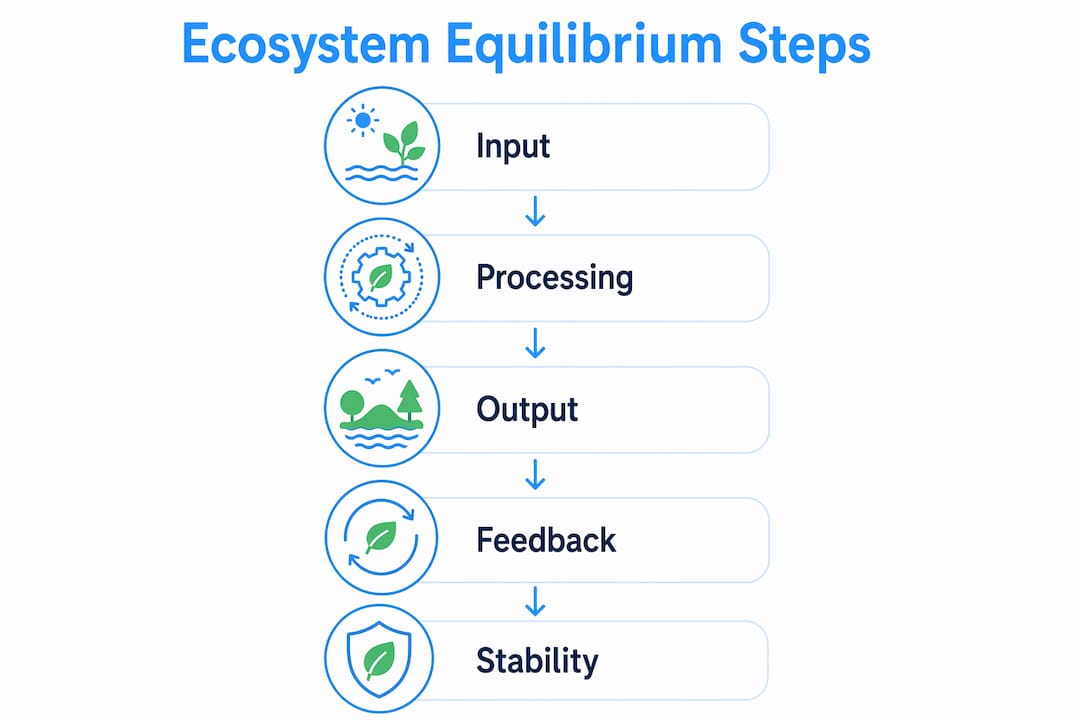
Energy and matter flow through ecosystems in predictable patterns. Sunlight enters, producers like grasses or phytoplankton capture it, consumers eat producers, and decomposers break down dead matter. Each step transfers energy and recycles nutrients. The system stays in balance as long as these flows remain proportional.
Feedback loops are the core mechanism behind how ecosystems maintain equilibrium:
- Negative feedback loops slow or suppress change and push the system back toward its stable state. A classic example: when a deer population grows too large, food becomes scarce, the population drops, and vegetation recovers.
- Positive feedback loops amplify change and push the system further from equilibrium. Melting Arctic sea ice exposes darker ocean water, which absorbs more heat, which melts more ice. This is a positive feedback accelerating change.
Negative feedbacks act through indirect routes involving predation, competition, and decomposition. Equilibrium is rarely maintained by a single direct relationship. It emerges from multiple interacting pathways across the food web.
Pro Tip: When studying feedback loops for your IB ESS exam, always identify whether a feedback is negative or positive by asking: does this change reinforce itself or reverse itself? That single question will help you answer most exam questions on ecosystem stability correctly.
What roles do resistance and resilience play in ecosystem stability?
Resistance and resilience are the two core measures of ecological stability. Resistance describes how well an ecosystem withstands a disturbance without changing. Resilience describes how fast it returns to equilibrium after a disturbance occurs. These two properties often trade off against each other.

Human activities are the leading cause of reduced resistance and resilience worldwide. Deforestation removes species diversity, which weakens the feedback networks that stabilize ecosystems. Pollution disrupts nutrient cycles. Invasive species like the cane toad in Australia or kudzu vine in the southeastern United States outcompete native species and destabilize food webs. Each of these pressures reduces the system’s capacity to absorb and recover from further shocks.
When disturbances exceed a system’s threshold, equilibrium can fail. Recovery takes longer, or the ecosystem shifts permanently into a different stable state. Ecologists call this a regime shift. The collapse of cod fisheries in the Northwest Atlantic is a documented regime shift. Overfishing pushed the system past its threshold, and the cod population did not recover even after fishing stopped.
Factors that influence resistance and resilience include:
- Species diversity: More species means more functional redundancy and stronger feedback networks.
- Habitat complexity: Structurally diverse habitats like coral reefs or old-growth forests buffer disturbances more effectively.
- Disturbance frequency: Frequent small disturbances can build resilience. Rare but massive disturbances often overwhelm it.
- Human pressure: Pollution, land use change, and climate change all reduce both resistance and resilience simultaneously.
Pro Tip: For your IB ESS internal assessment, consider designing an investigation around a local ecosystem that has experienced a disturbance. Measuring recovery rates gives you direct evidence of resilience, which is a concept examiners love to see applied in real contexts.
Can ecosystems have more than one stable equilibrium?
Modern ecology recognizes that many ecosystems have more than one possible stable state. This concept is called multiple stable equilibria. It means the outcome of ecosystem recovery depends on initial conditions, species assembly history, and the nature of the disturbance. Two identical ecosystems disturbed in different ways may end up in completely different stable states.
The distinction between a single globally stable equilibrium and multiple stable equilibria matters enormously for predicting ecosystem recovery. If an ecosystem has only one stable state, it will always return to the same configuration after a disturbance. If it has multiple stable states, the recovery path determines which stable community forms.
The table below compares these two types of equilibrium:
| Feature | Single Stable Equilibrium | Multiple Stable Equilibria |
|---|---|---|
| Recovery outcome | Always returns to the same state | May shift to a different stable state |
| Predictability | High | Lower, depends on disturbance history |
| Real-world examples | Small, isolated ponds with simple food webs | Coral reefs, forest-savanna transitions |
| Management implication | Restore conditions and recovery follows | Must identify which state is being targeted |
| Risk of regime shift | Lower | Higher if thresholds are crossed |
Coral reefs illustrate this well. A healthy coral reef and an algae-dominated reef can both be stable. Overfishing removes herbivorous fish that graze algae. Without that grazing pressure, algae outcompetes coral. The reef shifts to an algae-dominated state and stays there even if fishing stops. The initial conditions and assembly history locked in the new equilibrium.
Forest-savanna transitions in sub-Saharan Africa show the same pattern. Fire frequency, rainfall, and grazing pressure interact to determine whether a landscape stabilizes as forest or savanna. Both are valid stable states. Which one persists depends on the history of the system.
Why is ecosystem equilibrium important for biodiversity and ecosystem services?
Stable ecosystem balance directly supports biodiversity and the ecosystem services that human societies depend on. When equilibrium holds, species populations remain within sustainable ranges, habitats stay intact, and nutrient cycles function normally. When equilibrium breaks down, these services degrade.
Ecosystem balance sustains nutrient cycling, air and water purification, and climate regulation. These are not abstract benefits. Nutrient cycling feeds agriculture. Water purification reduces treatment costs. Climate regulation keeps weather patterns predictable. Every one of these services depends on a functioning, balanced ecosystem.
The importance of ecosystem stability becomes clearest when you look at what happens without it:
- Nutrient cycle disruption: Deforestation in the Amazon Basin reduces the water cycle, lowering rainfall across the region and affecting agriculture thousands of miles away.
- Loss of pollination services: Declining bee populations, driven partly by habitat loss and pesticide use, threaten crop yields globally.
- Climate feedback acceleration: Degraded wetlands release stored carbon, which accelerates warming, which further degrades wetlands.
- Fishery collapse: Overfishing removes key species, disrupts food webs, and can permanently reduce fish stocks as seen in the Grand Banks cod collapse.
Biodiversity’s role in maintaining equilibrium is direct. More species means more functional redundancy. If one species is lost, another can often fill its role. Low-diversity ecosystems lack this buffer. They are more vulnerable to disturbance and slower to recover. This is why conservation biologists prioritize biodiversity as a measure of ecosystem health, not just as a value in itself.
Sustainable land management practices, including those applied in sustainable gardening, reflect the same principles at a smaller scale. Maintaining soil health, supporting pollinators, and avoiding chemical overuse all mirror the feedback-based logic of ecosystem equilibrium.
Key takeaways
Ecosystem equilibrium is a dynamic, feedback-driven steady state that requires biodiversity, balanced inputs and outputs, and functional resilience to persist against disturbance.
| Point | Details |
|---|---|
| Equilibrium is dynamic, not static | The system adjusts constantly through feedbacks while maintaining overall stability. |
| Resistance and resilience are distinct | Resistance prevents change; resilience measures recovery speed after disturbance occurs. |
| Multiple stable states exist | Ecosystems can shift to a different stable state if disturbances cross critical thresholds. |
| Biodiversity strengthens stability | Higher species diversity creates more feedback pathways and greater functional redundancy. |
| Ecosystem services depend on balance | Nutrient cycling, climate regulation, and water purification all require a stable ecosystem. |
Why students often misunderstand ecosystem equilibrium
One of the most common mistakes I see in IB ESS students is confusing ecological equilibrium with thermodynamic equilibrium. In thermodynamics, equilibrium means no energy flow and no change. In ecology, it means the opposite. Ecological steady-state balance is maintained by constant energy flow, not by its absence. The system is always moving. It just moves in ways that keep the overall structure intact.
The second confusion I encounter is treating equilibrium as a single fixed point. Students sometimes write about ecosystems “returning to normal” after a disturbance, as if there is one correct state. The research on multiple stable equilibria shows this is not always true. History matters. The state an ecosystem recovers to depends on what happened before, which species are present, and how the disturbance unfolded.
For educators, I think the most effective way to teach this concept is through real case studies with measurable outcomes. The cod fishery collapse, the coral reef phase shift, the Yellowstone wolf reintroduction. These are not just interesting stories. They are documented examples of thresholds, regime shifts, and the role of keystone species in maintaining equilibrium. Students remember them, and they apply them correctly in exams.
My honest advice to students: do not memorize the definition of ecosystem equilibrium and move on. Spend time understanding why feedbacks work the way they do. Ask what would happen if one species or process were removed. That kind of thinking is what examiners reward at the highest mark bands.
— Marija
Deepen your understanding of ecosystem equilibrium with Esstutor
If ecosystem equilibrium feels like a concept you want to truly master, not just recognize on a multiple-choice question, Esstutor is here to help. With over 13 years of IB ESS teaching and examining experience, I work with students one-on-one to build real understanding of topics like ecological stability, feedback loops, and regime shifts.
Whether you are working on your ESS extended essay or preparing for Paper 1 and Paper 2 exams, personalized sessions at Esstutor are built around your specific needs and gaps. You can also explore IB ESS internal assessment examples to see how ecosystem concepts translate into strong IA investigations. Book a trial lesson and find out how targeted support can change your results.
FAQ
What is the ecosystem balance definition in simple terms?
Ecosystem balance, also called ecosystem equilibrium, is the condition where organisms and their environment remain stable over time through constant interactions and feedback loops. The system changes moment to moment but holds its overall structure.
How do ecosystems maintain equilibrium after a disturbance?
Ecosystems recover through negative feedback loops that slow or reverse change, such as predator-prey dynamics or nutrient cycling. Recovery speed depends on the ecosystem’s resilience and the severity of the disturbance.
What factors affect ecosystem equilibrium most?
Species diversity, habitat complexity, disturbance frequency, and human pressures like pollution and land use change are the primary factors affecting ecosystem balance. Higher biodiversity generally increases both resistance and resilience.
What is a regime shift and how does it relate to equilibrium?
A regime shift occurs when a disturbance pushes an ecosystem past a critical threshold, causing it to settle into a different stable state rather than recovering its original equilibrium. The Northwest Atlantic cod collapse is a documented example.
Why is ecosystem stability important for IB ESS students to understand?
Ecosystem stability connects directly to IB ESS topics including biodiversity, ecosystem services, human impacts, and environmental management. Examiners expect students to apply concepts like resistance, resilience, and feedback loops to real-world case studies.
No Comments