


20 Mar Why use remote tutoring for IB ESS success in 2026
Many IB Environmental Systems and Societies students assume remote tutoring can’t match the depth of in-person sessions or fit their packed schedules of exams, internal assessments, and CAS commitments. That misconception costs them valuable grade points. Remote tutoring has evolved into a flexible, expert-driven solution that addresses the unique demands of the IB Diploma Programme, offering personalized support that adapts to your timeline and learning style. This article reveals how remote tutoring delivers measurable academic gains, connects you with global ESS specialists, and transforms your exam readiness without adding travel time to your already busy life.
Table of Contents
- Understanding Remote Tutoring Mechanics For IB ESS
- Top Reasons Why Remote Tutoring Fits IB ESS Students’ Busy Schedules
- The Academic Impact Of Remote Tutoring On IB ESS Performance
- Choosing The Right Remote Tutor For IB ESS Success
- Get Expert Remote Tutoring For IB ESS Success
- Frequently Asked Questions
Key takeaways
| Point | Details |
|---|---|
| Flexibility maximizes study time | Remote tutoring eliminates commute and adapts to your IB schedule, fitting around CAS and other subjects. |
| Interactive tools enhance learning | Platforms like Zoom, shared documents, and session recordings personalize ESS instruction and reinforce complex case studies. |
| Consistent tutoring boosts grades | Regular sessions correlate with 1-2 grade level improvements, supported by empirical benchmarks. |
| Global expert access enriches understanding | Remote tutoring connects you with specialized ESS tutors worldwide, deepening exam readiness and internal assessment quality. |
Understanding remote tutoring mechanics for IB ESS
Remote tutoring for IB Environmental Systems and Societies operates through interactive platforms like Zoom, shared documents, and recorded sessions tailored to the IB syllabus. These tools create a personalized learning environment where tutors align lessons with internal assessment criteria, past paper strategies, and exam techniques specific to ESS. Unlike generic online courses, remote tutoring adapts to your individual strengths and gaps, whether you’re struggling with systems thinking or need targeted feedback on your IA research question.
Session recordings provide a unique advantage for reviewing intricate ESS case studies and revisiting explanations of biogeochemical cycles or sustainability models. You can pause, rewind, and absorb material at your own pace, reinforcing concepts that might blur during live discussions. This flexibility transforms tutoring into an on-demand resource, not just a weekly appointment.
Key tutor activities include:
- Designing interactive lessons that mirror IB exam question formats
- Providing tailored feedback on essays and internal assessment drafts
- Strategizing exam approaches for Paper 1 and Paper 2
- Clarifying syllabus connections between human systems and environmental value systems
- Guiding data analysis techniques for IA fieldwork
Pro Tip: Rewatch session recordings before exams to refresh your memory on complex ESS frameworks like the systems approach or the IPAT equation, turning past lessons into targeted review sessions.
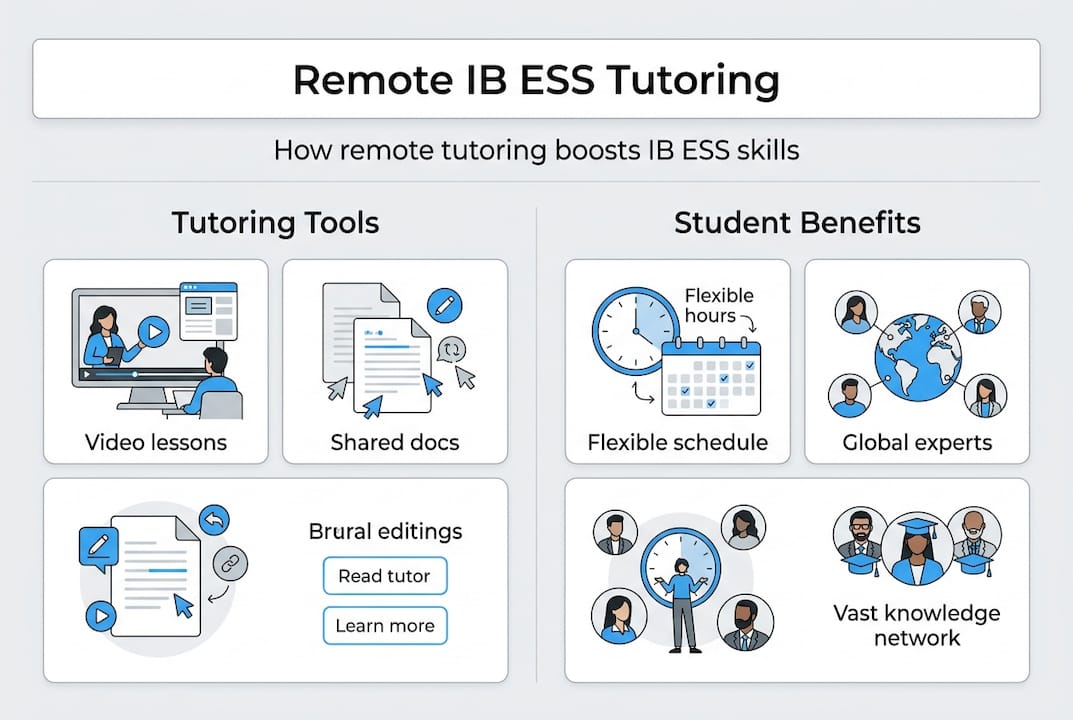
The mechanics of remote tutoring hinge on real-time collaboration. Shared Google Docs or digital whiteboards let you and your tutor co-edit notes, annotate diagrams of nutrient cycles, or map out IA methodologies together. This interactivity keeps sessions dynamic and ensures you’re not passively absorbing information. Tutors also integrate ESS notes and textbook resources directly into lessons, bridging gaps between coursework and exam expectations. The result is a seamless blend of technology and pedagogy that addresses the specific demands of why ESS online lessons are a game-changer for IB students.
Top reasons why remote tutoring fits IB ESS students’ busy schedules
IB Diploma students juggle Theory of Knowledge essays, Extended Essays, CAS projects, and six subjects simultaneously. Remote tutoring eliminates the time drain of commuting to a tutor’s office, freeing up hours you can redirect toward internal assessment preparation or other coursework. This convenience isn’t trivial when you’re balancing multiple deadlines and extracurricular commitments.
Flexible scheduling and global tutor access mean you’re not limited to local tutors who may lack specialized ESS expertise. You can connect with an IB examiner or a tutor who has guided dozens of students through successful IAs, regardless of time zones. This access is critical for ESS, a subject that demands nuanced understanding of interdisciplinary connections between ecology, economics, and ethics.
Key scheduling advantages include:
- Booking sessions around your school timetable and CAS activities
- Accessing tutors during weekends or evenings without geographic constraints
- Rescheduling sessions easily when unexpected commitments arise
- Learning from your comfortable study environment, reducing stress and travel fatigue
Time saved from commuting translates directly into more effective study. An extra hour per week over six months adds up to 24 hours of additional prep time, equivalent to several intensive review sessions before exams.
The flexibility of ESS online lessons also accommodates the unpredictable nature of IB workloads. When your Biology IA deadline collides with your ESS Paper 2 mock exam, remote tutoring lets you adjust session focus on the fly. Tutors can pivot from reviewing atmospheric systems to critiquing your IA draft within the same session, maximizing the value of every minute.
Global tutor access enriches your learning by exposing you to diverse teaching styles and regional case studies. A tutor in Europe might bring insights on renewable energy policies, while one in Asia could share examples of urban sustainability projects. This breadth deepens your understanding of ESS as a truly global subject, preparing you for exam questions that demand cross-cultural environmental perspectives. Remote tutoring transforms geographic distance into an educational asset, not a barrier.

The academic impact of remote tutoring on IB ESS performance
Empirical research on tutoring effectiveness provides a benchmark for what IB ESS students can expect. Studies show effect sizes of 0.2 to 0.4 standard deviations, which translate to approximately 1 to 2 grade level improvements when students engage in consistent tutoring sessions. For an IB ESS student hovering at a 5, this could mean reaching a 6 or even a 7 with targeted support.
These gains stem from personalized feedback loops that remote tutoring enables. Your tutor identifies specific weaknesses in your understanding of ecological footprints or pollution management strategies, then designs lessons to address those gaps. This precision contrasts sharply with classroom instruction, where teachers must balance the needs of 20+ students. Remote tutoring offers the individualized attention that accelerates mastery of complex ESS concepts.
The table below illustrates typical academic improvements from tutoring:
| Effect Size | Grade Improvement | Sessions Required |
|---|---|---|
| 0.2 SD | +1 grade level | 15-20 sessions |
| 0.3 SD | +1.5 grade levels | 20-30 sessions |
| 0.4 SD | +2 grade levels | 30-40 sessions |
Pro Tip: Schedule weekly sessions consistently rather than cramming before exams. Regular review and feedback loops with your tutor maximize these gains by building cumulative understanding, not just short-term memorization.
Remote tutoring also enhances your performance on internal assessments, a critical component of your final ESS grade. Tutors guide you through the IA process, from formulating a focused research question to analyzing data using appropriate statistical methods. They help you align your work with IB criteria, ensuring your IA demonstrates personal engagement, exploration depth, and clear communication. This structured support often makes the difference between a mediocre IA score and one that boosts your overall grade.
Exam skills improve as tutors teach you how to deconstruct command terms like “evaluate” or “discuss,” which carry specific expectations in IB ESS. They walk you through past papers, showing you how to allocate time across questions and structure responses that earn full marks. This strategic preparation, combined with content mastery, positions you to perform confidently under exam conditions. The academic impact of ESS online lessons extends beyond grades, building skills like critical thinking and evidence-based argumentation that serve you well beyond the IB Diploma.
Choosing the right remote tutor for IB ESS success
Selecting an effective remote tutor requires evaluating qualifications, teaching approach, and alignment with IB ESS requirements. Not all tutors understand the nuances of the ESS syllabus or the specific demands of internal assessments. Following a systematic selection process ensures you invest time and resources in a tutor who can deliver measurable results.
- Verify qualifications and credentials. Look for tutors with formal education in environmental science, geography, or related fields, plus experience teaching IB ESS. Ideally, your tutor should have worked as an IB examiner or moderator, giving them insider knowledge of how assessments are graded.
- Confirm IB ESS syllabus expertise. Ask potential tutors to explain how they address systems thinking, the ESS assessment model, or specific topics like climate change mitigation. Their ability to articulate these concepts signals depth of knowledge.
- Assess personalization and adaptive teaching. A great IB ESS tutor tailors lessons to your learning style, whether you’re a visual learner who benefits from diagrams or someone who needs step-by-step guidance through calculations. Request a trial session to gauge their flexibility.
- Evaluate IA and exam preparation experience. Tutors should demonstrate a track record of guiding students through successful internal assessments and improving exam scores. Ask for examples of how they’ve helped past students refine research questions or structure exam responses.
- Review student testimonials or conduct trial sessions. Feedback from other IB ESS students provides insight into a tutor’s effectiveness. A trial session lets you assess rapport, communication style, and whether their teaching approach resonates with you.
Personalized tutoring plans aligned with IB criteria require tutors who understand the ESS IB assessment model, including how marks are distributed across knowledge, application, and synthesis. Tutors should also stay updated on syllabus changes and exam trends, ensuring their instruction reflects current IB expectations. This alignment is non-negotiable for maximizing your tutoring investment.
Beware of tutors who offer generic science tutoring without IB-specific expertise. ESS is unique in its interdisciplinary focus, blending natural sciences with social sciences and requiring students to analyze environmental issues through multiple lenses. Your tutor must navigate this complexity, helping you connect topics like energy transformations to societal impacts and ethical frameworks. The right tutor transforms abstract ESS concepts into concrete, exam-ready knowledge.
Get expert remote tutoring for IB ESS success
Achieving top grades in IB Environmental Systems and Societies demands more than classroom instruction. Specialized remote tutoring provides the personalized support you need to excel in exams and internal assessments. Our IB ESS internal assessment tutors bring over 13 years of IB examining and teaching experience, guiding you through every stage of your IA from research design to final submission. We align our lessons with IB criteria, ensuring your work meets the standards that earn high marks.
Beyond tutoring, we offer comprehensive ESS notes and textbook resources that reinforce your learning and provide quick reference materials for exam prep. Our ESS IB exam resources include past paper walkthroughs, command term guides, and topic-specific strategies that build your confidence and competence. Whether you’re aiming to improve your understanding of systems thinking or need targeted feedback on essay structure, our remote tutoring adapts to your goals. Take the first step toward IB ESS success by exploring our services today.
Frequently asked questions
What is remote tutoring and how does it benefit IB ESS students?
Remote tutoring consists of live online lessons conducted via platforms like Zoom, where specialized tutors provide personalized instruction tailored to IB Environmental Systems and Societies. Benefits include flexible scheduling that fits around your CAS activities and other IB subjects, elimination of commute time, and access to expert tutors worldwide regardless of your location. This format helps IB ESS students manage heavy workloads while receiving targeted support for exams and internal assessments, ultimately improving both understanding and grades.
How does remote tutoring improve IB ESS exam performance?
Remote tutoring improves exam performance by providing personalized feedback, clarifying complex content, and teaching exam-specific techniques like deconstructing command terms and structuring high-scoring responses. Research shows tutoring produces gains of 0.2 to 0.4 standard deviations, translating to 1 to 2 grade level improvements with consistent sessions. Tutors guide you through past papers, identify knowledge gaps, and build strategic approaches that boost confidence and competence under exam conditions.
Can remote tutoring help with the IB ESS Internal Assessment?
Yes, remote tutoring significantly enhances IA quality by guiding you through project design, research question formulation, data collection methods, and analysis aligned with IB criteria. Tutors provide customized feedback on drafts, helping you demonstrate personal engagement, exploration depth, and clear communication that meet IB standards. This structured support ensures your IA adheres to the assessment model and maximizes your score, a critical component of your final ESS grade.
How do I know if a remote tutor is qualified for IB ESS?
Qualified IB ESS tutors possess formal education in environmental science or related fields, experience teaching the IB ESS syllabus, and ideally have worked as IB examiners or moderators. Verify their ability to explain systems thinking, the ESS assessment model, and specific syllabus topics in depth. Request a trial session to assess their teaching style, personalization approach, and track record of guiding students through successful internal assessments and exam preparation.
What technology do I need for remote ESS tutoring sessions?
You need a reliable internet connection, a device with a camera and microphone such as a laptop or tablet, and access to video conferencing software like Zoom. Many tutors also use shared documents via Google Docs or digital whiteboards for collaborative note-taking and diagram annotation. Having a quiet, comfortable study space enhances focus and engagement during sessions, while session recordings require sufficient storage on your device or cloud service for later review.
No Comments