


04 Apr IB ESS internal assessment guide: Step-by-step for top scores
TL;DR:
- High-scoring IB ESS IAs are clear, well-structured, and connect findings to real-world issues.
- Choosing a local, relevant environmental topic and refining a specific, testable question is essential.
- Focusing on honest reflection, systematic execution, and simplicity often leads to better results than overcomplicated work.
The IB ESS internal assessment (IA) is one of the most stressful parts of the Diploma Programme for many students. You have a topic to choose, an investigation to plan, data to collect, and a full report to write, all while keeping up with your other subjects. It’s a lot to manage. But here’s the thing: students who score well on their IA don’t necessarily work harder. They work smarter. High-scoring IAs share clear structure and real-world links, and that’s exactly what this guide will help you build, from your first brainstorm to your final reflection.
Table of Contents
- Understanding the IB ESS internal assessment requirements
- How to choose and refine your ESS IA topic
- Planning your investigation: Tools, materials, and process
- Executing, processing, and reflecting: Writing your ESS IA for top marks
- The unconventional truth about mastering your ESS internal assessment
- Personalized support to master your ESS IA and exams
- Frequently asked questions
Key Takeaways
| Point | Details |
|---|---|
| Structure is essential | Clear organization and logical flow are crucial for high ESS IA scores. |
| Critical reflection matters | Examiners look for thoughtful analysis and honest evaluation of your investigation. |
| Topic relevance | Choosing a focused, real-world ESS question maximizes both interest and scoring potential. |
| Process over perfection | Following a step-by-step approach beats striving for perfect execution every time. |
| Tutoring boosts confidence | Personalized guidance helps you overcome challenges and score higher on your IA and exams. |
Understanding the IB ESS internal assessment requirements
The internal assessment is a student-led scientific investigation that counts toward your final IB ESS grade. It gives you the chance to explore a real environmental issue, collect and analyze data, and reflect critically on your findings. Unlike your exams, this is your opportunity to direct your own learning, which makes it both exciting and challenging.
The IA is assessed using a set of official IB criteria. Understanding these criteria is the foundation of a strong submission. Exemplar IAs highlight structure and critical reflection as the two most consistent features of high-scoring work. If you want to understand what examiners are really looking for, reviewing the ESS internal assessments guide is a great starting point.
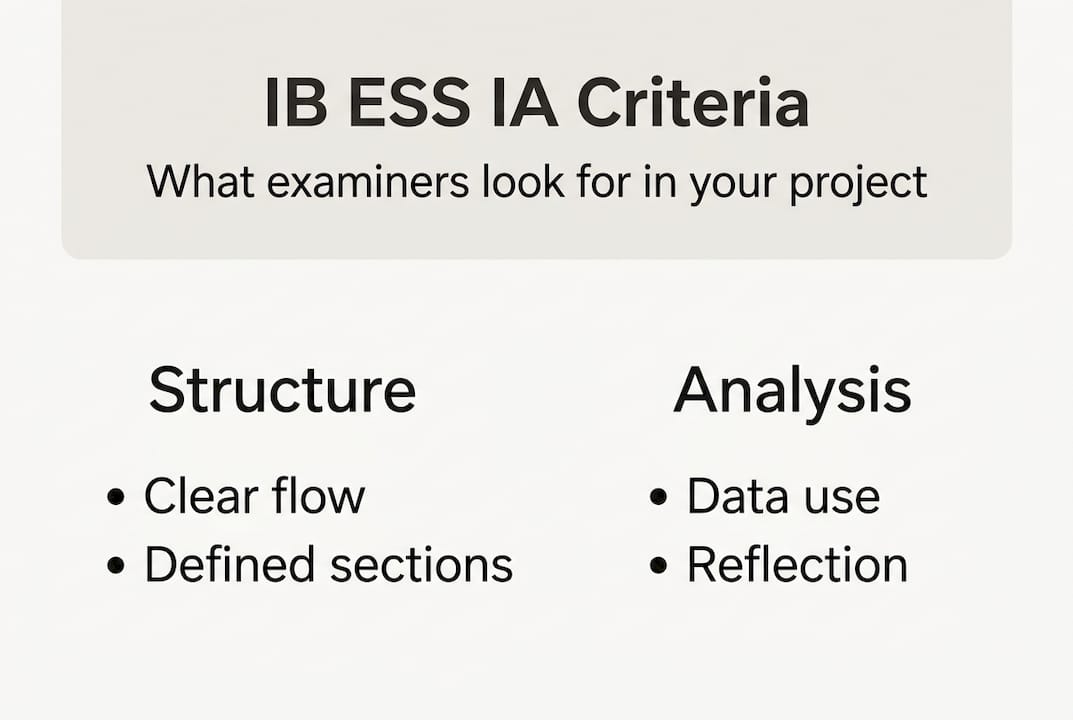
Here’s a breakdown of the core IA components and how they affect your score:
| IA component | What it involves | Scoring impact |
|---|---|---|
| Research question | Clear, focused, and testable | High |
| Methodology | Logical, repeatable process | High |
| Data collection | Organized, sufficient, relevant | High |
| Data processing | Statistical analysis and presentation | High |
| Conclusion and evaluation | Links findings to real-world context | Very high |
| Reflection | Critical assessment of your own work | High |
Every component matters. Skipping or rushing any one of them will cost you marks. Here are the essential requirements you need to meet:
- A clearly stated and focused research question
- A methodology that can be repeated and evaluated
- Raw data presented in organized tables or records
- Processed data with appropriate statistical methods
- A conclusion that connects your findings to ESS concepts
- An honest and specific evaluation of your process
“The best IAs don’t try to be perfect. They are clear, honest, and well-structured. Examiners reward students who show genuine scientific thinking, not just polished results.”
You can also browse internal assessment ideas to get a sense of what topics work well and why.
How to choose and refine your ESS IA topic
Once you understand the requirements, the next crucial step is choosing the right topic for your IA. This decision shapes everything that follows, so it’s worth taking your time here.
The best ESS IA topics are grounded in real environmental issues that you can actually investigate. Think about what you see in your local environment. Water quality in a nearby river, biodiversity in a local park, soil contamination near an industrial area, or light pollution in your neighborhood are all examples of topics that connect to ESS concepts and allow for genuine data collection.
High-scoring IAs emphasize real-world links, so choosing a topic with clear environmental relevance gives you an immediate advantage. For more inspiration, check out these ESS IA topics that have worked well for IB students.
Here’s a step-by-step process for narrowing your topic down to an IA-ready research question:
- Start broad. Pick an ESS theme you find genuinely interesting, such as water systems, biodiversity, or climate change.
- Go local. Identify a specific, real-world example of that issue in your area or one you can access.
- Ask a question. Frame your interest as a question, for example: “How does distance from a main road affect species diversity in roadside vegetation?”
- Check for testability. Can you collect measurable data to answer this question? If not, refine it.
- Evaluate scope. Is the question narrow enough to investigate in the time and with the resources you have?
- Align with criteria. Review the IB assessment criteria and confirm your question allows you to meet each one.
For detailed guidance on this process, the page on choosing an ESS IA topic walks you through what examiners look for in a strong research question.
Feasibility check: Can you obtain suitable evidence to answer your focused research question? Check access, measurement quality, practical constraints and how you will analyse the data. Choose evidence for its relevance to the question rather than requiring two different types of data.
Planning your investigation: Tools, materials, and process
You’ve got your topic. Now it’s time to organize your investigation for maximum clarity and efficiency. Poor planning is one of the most common reasons students lose marks, not because their ideas are bad, but because their process is unclear or incomplete.

Books with exemplar IAs provide process clarity by showing exactly how top students structure their methodology. Use that as your model. The ESS IA process success page also offers a practical framework you can adapt.
Here’s a planning overview to guide your preparation:
| Planning element | Examples | Timeline |
|---|---|---|
| Equipment and tools | pH meter, quadrats, water testing kits, thermometers | Week 1 |
| Data recording materials | Field notebooks, spreadsheets, data tables | Week 1 |
| Site or sample selection | Choosing locations, sample sizes, control variables | Week 1 to 2 |
| Pilot testing | Trial run of your method to check for issues | Week 2 |
| Full data collection | Executing your investigation across all samples | Week 3 to 4 |
Common planning mistakes to avoid:
- Not defining variables clearly. State your independent, dependent, and controlled variables explicitly.
- Collecting too little data. Aim for enough data points to allow meaningful statistical analysis.
- Skipping a pilot test. A quick trial run can reveal problems before you commit to your full investigation.
- Ignoring safety and ethical considerations. These must be addressed in your methodology.
- Forgetting to record raw data. Always keep your original, unprocessed data alongside your processed results.
For ideas on structuring your data collection, the ESS IA data collection resource covers survey-based approaches in detail.
Pro Tip: Before you begin your full investigation, run a short pilot test with a small sample. This helps you spot equipment issues, refine your process, and feel confident before collecting your main data set.
Executing, processing, and reflecting: Writing your ESS IA for top marks
With planning in place, let’s move on to investigation, analysis, and the writing that truly impresses examiners. This is where your preparation pays off.
Follow these steps to execute your investigation and organize your findings effectively:
- Collect data systematically. Follow your methodology exactly. Record everything, even unexpected observations.
- Organize raw data immediately. Use clear, labeled tables with units. Don’t wait until later to tidy your records.
- Process your data statistically. Use appropriate methods such as mean, standard deviation, or correlation analysis depending on your question.
- Present processed data visually. Graphs and charts make patterns clear. Label axes, include units, and add a descriptive title to every figure.
- Write your conclusion. Summarize what your data shows and link it directly to your research question and relevant ESS concepts.
- Evaluate your investigation. Identify specific limitations, explain how they affected your results, and suggest realistic improvements.
Statistical processing and critical reflection drive high scores, so don’t treat these as afterthoughts. They are central to your mark.
Critical reflection points to address in your evaluation:
- Were your sample sizes large enough to be representative?
- Did any variables go uncontrolled during data collection?
- How reliable was your equipment or measurement method?
- What would you do differently if you repeated this investigation?
- How do your findings connect to broader environmental issues or ESS theory?
“Don’t just say ‘human error’ as a limitation. Name the specific error, explain how it affected your data, and propose a concrete way to reduce it next time. That level of detail is what separates a 6 from a 7.”
For support with this stage, the ESS IA tutoring support page connects you with expert guidance, and the writing an ESS IA resource gives you a clear writing framework to follow.
The unconventional truth about mastering your ESS internal assessment
Here’s something most guides won’t tell you: the students who struggle most with the IA are often the ones trying hardest to make it perfect. They overthink their topic, rewrite their methodology five times, and spend so long polishing their introduction that they rush the evaluation. That’s a problem.
In my experience working with IB ESS students, the IAs that score highest are rarely the most elaborate. They are the clearest. A simple, well-executed investigation with honest reflection will consistently outperform a complex one that lacks structure or genuine critical thinking.
Examiners are not looking for groundbreaking science. They are looking for evidence that you understand the process, can analyze data appropriately, and can honestly assess your own work. That’s it.
So stop chasing perfection and start focusing on clarity. Does your research question make sense? Is your methodology easy to follow? Have you addressed every reflection point honestly? If yes, you are already ahead of most students. Browse creative IA ideas to find a topic that genuinely interests you, because engagement with your subject always shows in the writing.
Personalized support to master your ESS IA and exams
If you’ve found this guide helpful, imagine what it feels like to have this kind of support tailored specifically to your IA and your questions.
At esstutor.net, I work one-on-one with IB ESS students to help them plan, write, and refine their IAs with confidence. Whether you’re stuck on your research question, unsure about your data analysis, or need feedback on your draft, I can help. You can explore internal assessment examples to see what strong work looks like, read more about effective ESS IA writing, or go straight to the page that helps you boost your ESS IA score. A trial lesson is a great first step.
Frequently asked questions
What is the purpose of the IB ESS internal assessment?
The IA demonstrates your ability to conduct a scientific investigation, apply ESS concepts to real-world issues, and critically reflect on findings. It is a student-directed component that contributes directly to your final IB grade.
How do I choose a strong topic for my ESS IA?
Focus on real-world environmental issues you can access and investigate locally. Narrow your question until it is specific, testable, and clearly aligned with IB assessment criteria.
What common mistakes can lower my IA score?
Lack of structure, weak statistical analysis, and superficial reflection are the most frequent errors in lower-scoring IAs. High-scoring IAs emphasize structure, processing, and reflection consistently across all components.
How can personalized tutoring help with my ESS IA?
Tutoring provides targeted feedback on your specific work, helps you clarify your structure, and guides you step-by-step through planning, data collection, and writing so you approach each stage with confidence.
No Comments