


19 Mar Master the role of past papers for IB ESS exam success
Many IB ESS students believe rereading notes and highlighting textbooks will guarantee exam success. This misconception leads to passive revision that rarely translates to strong exam performance. Past papers offer an underused but powerful tool that actively prepares you for the specific demands of the 2026 IB ESS exams. They reveal question patterns, test your application skills, and build the confidence needed to excel under pressure. This guide explores how to integrate past papers strategically into your revision routine, transforming them from optional practice into your most effective exam preparation resource.
Table of Contents
- Understanding The Role Of Past Papers In IB ESS Preparation
- How To Effectively Use Past Papers For Environmental Systems And Societies
- Comparing Past Paper Practice With Other Revision Methods
- Practical Tips For Integrating Past Paper Practice Into Your ESS Study Routine
- Boost Your IB ESS Exam Performance With Expert Support
- Frequently Asked Questions
Key takeaways
| Point | Details |
|---|---|
| Question pattern recognition | Past papers expose recurring themes and question styles specific to IB ESS exams |
| Active knowledge application | They shift you from passive reading to active problem solving under realistic conditions |
| Targeted weakness identification | Regular practice reveals specific content gaps and timing issues before exam day |
| Exam confidence building | Familiarity with format and question types reduces anxiety and improves performance |
Understanding the role of past papers in IB ESS preparation
Past papers function as your most accurate preview of what examiners actually expect on test day. Unlike generic study guides, they show you the exact question formats, command terms, and depth of analysis required for Papers 1 and 2. Practicing with previous years’ exam papers significantly improves student familiarity with exam format and question types, giving you a concrete advantage over students who rely solely on memorization.
The real power of past papers lies in how they force active recall rather than passive recognition. When you read your notes, your brain creates a false sense of mastery because the information feels familiar. Past papers expose the gap between recognizing a concept and actually applying it to answer a complex question. You might understand ecosystem succession in theory, but can you analyze a case study, evaluate management strategies, and justify your reasoning within the time limit? This application under pressure reveals your true readiness.
Past papers also build crucial exam stamina that no other revision method provides. The IB ESS exam overview shows that Paper 1 runs 60 minutes while Paper 2 extends to 120 minutes, demanding sustained concentration and strategic time allocation. Practicing full papers under timed conditions trains your brain to maintain focus, pace yourself appropriately, and manage the mental fatigue that often derails unprepared students in the final sections.
Consider these specific benefits past papers deliver:
- They reveal which topics appear most frequently across exam sessions
- They show how examiners phrase questions differently while testing the same concept
- They expose common traps and misconceptions that cost students marks
- They demonstrate the level of detail and evidence required for top band responses
Pro Tip: Create a question bank by topic as you work through past papers. When you encounter a challenging question on biodiversity or climate change, add it to your topic specific collection. This builds a personalized revision resource targeting your actual weak areas rather than generic problem sets.
“The difference between knowing the content and scoring well comes down to exam technique. Past papers are where you develop that technique through deliberate practice.”
How to effectively use past papers for Environmental Systems and Societies
Using past papers effectively requires more than simply attempting questions whenever you feel like it. A structured approach transforms them from occasional practice into a systematic preparation tool. Start by creating exam conditions that mirror the actual test environment. Find a quiet space, set a timer for the exact paper duration, and eliminate all distractions including notes and phones. This simulation builds the mental discipline needed to perform under genuine exam pressure.

After completing each paper, the review phase matters even more than the initial attempt. Resist the urge to immediately check answers while emotions run high. Take a break, then return with the mark scheme and model answers. Compare your responses line by line, identifying not just wrong answers but also where your reasoning diverged from top scoring responses. This analytical review teaches you how examiners think and what they prioritize when awarding marks.
Students improve exam performance when using past papers in a structured, timed, and reviewed manner, particularly when they track patterns in their mistakes. Create a simple error log noting whether mistakes stem from content gaps, misreading questions, poor time management, or weak exam technique. This data driven approach prevents you from wasting revision time on areas you already master while neglecting genuine weaknesses.
Follow this proven sequence for maximum benefit:
- Attempt the paper under full exam conditions without any aids
- Score your work honestly using the official mark scheme
- Identify three specific areas where you lost the most marks
- Review relevant content and reattempt similar questions from other papers
- Track improvement over time to confirm weak areas are strengthening
Pro Tip: Practice Paper 1 and Paper 2 questions separately at first. Paper 1 emphasizes case studies and data response requiring quick analysis, while Paper 2 demands longer essays with structured arguments. Master the distinct skills each paper requires before attempting full length exams. Understanding the IB ESS assessment model helps you appreciate why this separation matters.
When reviewing essay questions, pay special attention to command terms like “evaluate,” “discuss,” and “to what extent.” These words dictate the structure and depth your answer requires. An “evaluate” question demands you present multiple perspectives with evidence before reaching a justified conclusion. Missing this requirement costs marks even when your content knowledge is solid.
Comparing past paper practice with other revision methods
Past papers occupy a unique position in your revision toolkit that other methods cannot replicate. While flashcards excel at memorizing definitions and key facts, they provide zero practice applying that knowledge to novel scenarios. You might perfectly recall the definition of ecological footprint through flashcard drilling, but can you calculate it from data, compare it across countries, and evaluate its limitations as an environmental indicator? Past papers force this higher order thinking that separates strong from exceptional exam performance.
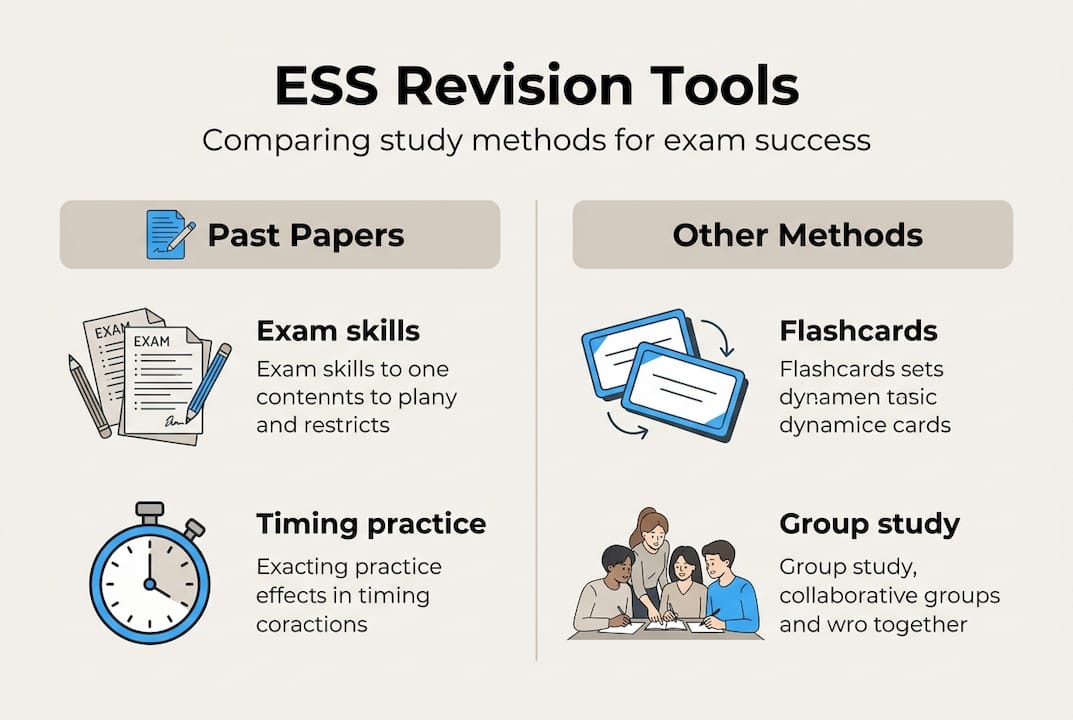
Group study sessions offer valuable peer learning and motivation but lack the individual accountability and exam simulation past papers provide. Discussing concepts with classmates helps clarify misunderstandings and exposes different perspectives. However, you cannot collaborate during the actual exam. Past paper use complements but should not completely replace comprehensive note review and understanding, creating a balanced revision approach that builds both knowledge and application skills.
Consider how different methods serve distinct purposes in your revision plan:
| Method | Best For | Limitations |
|---|---|---|
| Past papers | Exam technique, timing, application under pressure | Time intensive, requires mark schemes for effective review |
| Flashcards | Quick recall of definitions, facts, and key terms | No context or application practice |
| Note review | Understanding concepts, building knowledge foundation | Passive, creates false confidence |
| Group study | Clarifying confusion, peer teaching, motivation | Not exam focused, social distractions possible |
| Video tutorials | Visual learning, complex processes, engaging content | Passive consumption without active practice |
The most effective revision strategies integrate multiple methods strategically. Use note review and video tutorials early in your revision to build solid conceptual understanding. Add flashcards for memorizing specific data, case studies, and terminology. Then prioritize past papers in the final weeks to sharpen exam technique and identify any remaining gaps. This progression ensures you develop both the knowledge base and the application skills needed for top scores.
Past papers also reveal question trends that other methods miss entirely. After working through five years of papers, you will notice certain topics appear repeatedly while others rarely feature. This pattern recognition lets you prioritize high yield content without gambling on what might appear. The ESS coursework tips similarly emphasize strategic focus over attempting to master every possible topic equally.
Practical tips for integrating past paper practice into your ESS study routine
Integrating past papers effectively requires intentional scheduling rather than sporadic attempts when motivation strikes. Block specific weekly time slots dedicated exclusively to timed paper practice, treating these sessions as non negotiable appointments. Early in your revision cycle, allocate one three hour block per week for a full paper plus review. As exams approach, increase this to two or three sessions weekly, ensuring you experience exam conditions regularly enough to build genuine comfort and automaticity.
Tracking your progress systematically transforms past paper practice from isolated attempts into a data driven improvement process. Create a simple spreadsheet logging each paper attempted, your score by section, recurring mistake patterns, and topics requiring additional review. This visual record reveals whether your scores trend upward over time and whether specific weaknesses persist despite targeted study. Structured revision calendars incorporating regular past paper sessions yield better exam outcomes by making improvement measurable and adjustments strategic.
Balance past paper sessions with other essential revision components to avoid burnout and maintain comprehensive preparation. A sustainable weekly schedule might include:
- Monday: Content review and note consolidation for Topic 1-3
- Tuesday: Flashcard drilling and case study memorization
- Wednesday: Full Paper 1 under timed conditions
- Thursday: Review Wednesday’s paper and target weak areas
- Friday: Internal Assessment work and data analysis practice
- Saturday: Full Paper 2 under timed conditions
- Sunday: Review Saturday’s paper and rest
Pro Tip: Mix recent papers with older ones to expose yourself to diverse question styles and difficulty levels. Recent papers reflect current examiner priorities and syllabus emphasis, while older papers sometimes include creative question formats that still appear occasionally. This variety prevents you from becoming too comfortable with predictable patterns.
Your past paper strategy should evolve as exams approach. Use this progression timeline:
| Revision Phase | Past Paper Focus | Frequency |
|---|---|---|
| Early (3+ months out) | Individual sections and question types | One section weekly |
| Mid (2-3 months out) | Full papers with extended review time | One full paper weekly |
| Late (1 month out) | Multiple full papers, strict timing | Two papers weekly |
| Final (2 weeks out) | Recent papers, weak topic targeting | Three papers weekly |
Connect your past paper insights directly to content revision by maintaining a running list of topics requiring deeper study. When a paper exposes shaky understanding of soil degradation or uncertainty about pollution management strategies, immediately schedule focused review sessions on those specific areas before attempting another paper. This responsive approach ensures past papers drive targeted improvement rather than simply confirming existing knowledge gaps repeatedly. The IB ESS learning resources 2026 provide excellent supplementary materials for filling these identified gaps efficiently.
Boost your IB ESS exam performance with expert support
While past papers provide invaluable exam preparation, combining them with expert guidance accelerates your progress dramatically. Professional tutors who serve as IB examiners understand exactly what mark schemes reward and can decode why certain answers score full marks while seemingly similar responses fall short. This insider perspective transforms past paper review from guesswork into targeted skill development.
Specialized IB ESS IA tutors offer personalized feedback on your past paper attempts, identifying subtle technique issues you might miss when self reviewing. They can explain why your evaluation lacked balance, how to structure discussions more effectively, or where you need stronger evidence to support claims. Access comprehensive IB ESS notes and textbook resources that complement past paper practice with clear explanations and case study summaries. For Paper 2 specifically, targeted IB ESS Paper 2 resources help you master the extended response format that challenges many students. Expert support ensures your past paper practice builds the precise skills examiners value most.
Frequently asked questions
What past papers should I focus on for IB ESS exams?
Prioritize papers from the last five years as they reflect current syllabus content and examiner expectations most accurately. Focus equally on Paper 1 and Paper 2 since they test different skills, with Paper 1 emphasizing data response and case studies while Paper 2 requires extended essays. Include at least two complete practice sessions for each paper type. The IB ESS Paper 1 practice resources help you understand the specific demands of multiple choice and short answer formats.
How often should I practice past papers during revision?
Aim for one full past paper every one to two weeks during mid revision phases, roughly two to three months before exams. Increase frequency to one paper every three to four days as your exam date approaches within the final month. Intersperse past paper sessions with content review, flashcard practice, and Internal Assessment work to maintain balanced preparation without burning out. The ESS revision calendar planning guide provides detailed scheduling strategies for optimal timing.
Should I complete past papers with or without notes initially?
Always attempt past papers under full exam conditions without any notes or aids for your first attempt. This honest assessment reveals your true readiness and identifies genuine knowledge gaps versus areas where you simply need memory prompts. After scoring and reviewing your attempt, you can reattempt challenging questions with notes to reinforce learning and build connections between concepts. The goal is building independence and confidence for exam day when no resources will be available.
Can past papers help reduce exam anxiety for IB ESS?
Absolutely. Familiarity with exam format through repeated past paper practice eliminates the fear of the unknown that fuels much exam anxiety. Students who practice past papers regularly experience lower exam anxiety and greater confidence because they know exactly what to expect on test day. Timed practice also builds mental endurance and teaches you to stay calm under pressure when unexpected questions appear. The more papers you complete, the more automatic your exam responses become, freeing mental energy from worry to focus on demonstrating your knowledge. Additional strategies for overcoming exam anxiety complement past paper practice for comprehensive stress management.
How do I effectively review past papers after completing them?
Score your work honestly using official mark schemes, then analyze each lost mark to identify the specific reason. Create categories like content gaps, misread questions, weak exam technique, or time management issues. Focus your next study sessions on the highest frequency error category rather than trying to fix everything simultaneously. Compare your essay responses to model answers line by line, noting how top responses structure arguments, integrate evidence, and address command terms. This analytical review teaches you to think like an examiner and recognize what separates good answers from exceptional ones.
No Comments