


18 Mar What is environmental policy? IB ESS guide for 2026
Environmental policy shapes everything from air quality regulations to climate agreements, yet many IB ESS students struggle to define it beyond “rules about nature.” This confusion is understandable because environmental policy refers to principles, rules, regulations, and strategies designed to protect the environment and promote sustainability by regulating human activities to minimize negative impacts and balance economic development with preservation, covering far more than just laws. This guide breaks down what environmental policy actually is, the tools governments use, how policies develop through cycles, and real-world evidence of their impact. Understanding these concepts will sharpen your analysis for IB Environmental Systems and Societies coursework, internal assessments, and exams.
Table of Contents
- Understanding Environmental Policy: Definition And Scope
- Key Tools And Instruments Of Environmental Policy
- How Environmental Policies Develop: The Policy Cycle Explained
- Real-World Impacts And Complexities Of Environmental Policies
- Get Expert Help Mastering IB ESS Environmental Policy
Key takeaways
| Point | Details |
|---|---|
| Definition and scope | Environmental policy encompasses principles, regulations, strategies, and enforcement mechanisms that balance economic development with ecosystem protection and sustainability goals. |
| Four main policy tools | Regulatory instruments like emission standards, market-based mechanisms like cap-and-trade, voluntary programs, and rights-based approaches each offer distinct strengths for achieving environmental objectives. |
| Six-stage policy cycle | Policies develop through agenda setting, formulation, decision/adoption, implementation, evaluation/monitoring, and iteration to address problems and improve effectiveness over time. |
| Evidence-based effectiveness | Stricter policies reduce pollution by 10-27% and save hundreds of thousands of lives, with policy mixes creating synergies that amplify emissions reductions from 10% to 22%. |
| Complexity requires nuance | Real-world success depends on coherent policy design, managing synergies and conflicts, and adapting to political, economic, and social contexts rather than relying on single instruments. |
Understanding environmental policy: definition and scope
Environmental policy is the framework societies use to manage their relationship with the natural world. At its core, it consists of principles, rules, regulations, and strategies designed to protect ecosystems, control pollution, conserve biodiversity, mitigate climate change, and manage natural resources sustainably. These policies aim to regulate human activities that harm the environment while balancing the need for economic development and social well-being.
Many students think environmental policy only means laws passed by governments. That’s incomplete. Policy includes much more than legal statutes. It encompasses voluntary initiatives, market-based incentives, educational campaigns, and even recognition of nature’s rights. For example, carbon pricing schemes encourage businesses to reduce emissions without strict mandates, while community-led conservation programs rely on voluntary participation.
Environmental policy pursues several interconnected goals. Pollution control reduces harmful emissions to air, water, and soil. Biodiversity conservation protects species and habitats from destruction. Climate change mitigation limits greenhouse gas emissions and promotes renewable energy. Resource management ensures sustainable use of forests, fisheries, and minerals for future generations. These goals often overlap, requiring integrated approaches that address multiple issues simultaneously.
Key components of environmental policy include:
- Regulatory frameworks that set standards and prohibit harmful activities
- Economic instruments like taxes and subsidies that change behavior through financial incentives
- Information and education programs that raise awareness and build capacity
- Enforcement mechanisms including monitoring, penalties, and compliance systems
- Institutional structures that coordinate policy development and implementation across agencies
Understanding this broad scope helps you analyze how different policy approaches connect to environmental management concepts you study in IB ESS. It also clarifies the relationship between policy and environmental law essentials, where laws represent just one tool within the larger policy toolkit. Recognizing this distinction will strengthen your ability to evaluate real-world environmental strategies in assessments.
Pro Tip: When analyzing environmental policies in essays or case studies, always identify which type of instrument is being used and explain why that approach fits the specific problem context.
Key tools and instruments of environmental policy
Governments and organizations deploy four main categories of policy instruments to achieve environmental goals, each with distinct mechanisms and trade-offs. Key policy instruments include regulatory tools like emission standards, market-based instruments like cap-and-trade, voluntary measures, and rights-based approaches such as rights of nature. Understanding these differences is essential for evaluating policy effectiveness in IB ESS coursework.

Regulatory instruments, also called command-and-control approaches, set mandatory standards and prohibit certain activities. Examples include emission limits for factories, environmental impact assessments (EIAs) before major projects, and bans on harmful substances like CFCs. These tools provide clear rules and direct control, making them effective when rapid action is needed or when activities pose severe risks. However, they can be inflexible, costly to enforce, and may not encourage innovation beyond minimum compliance.
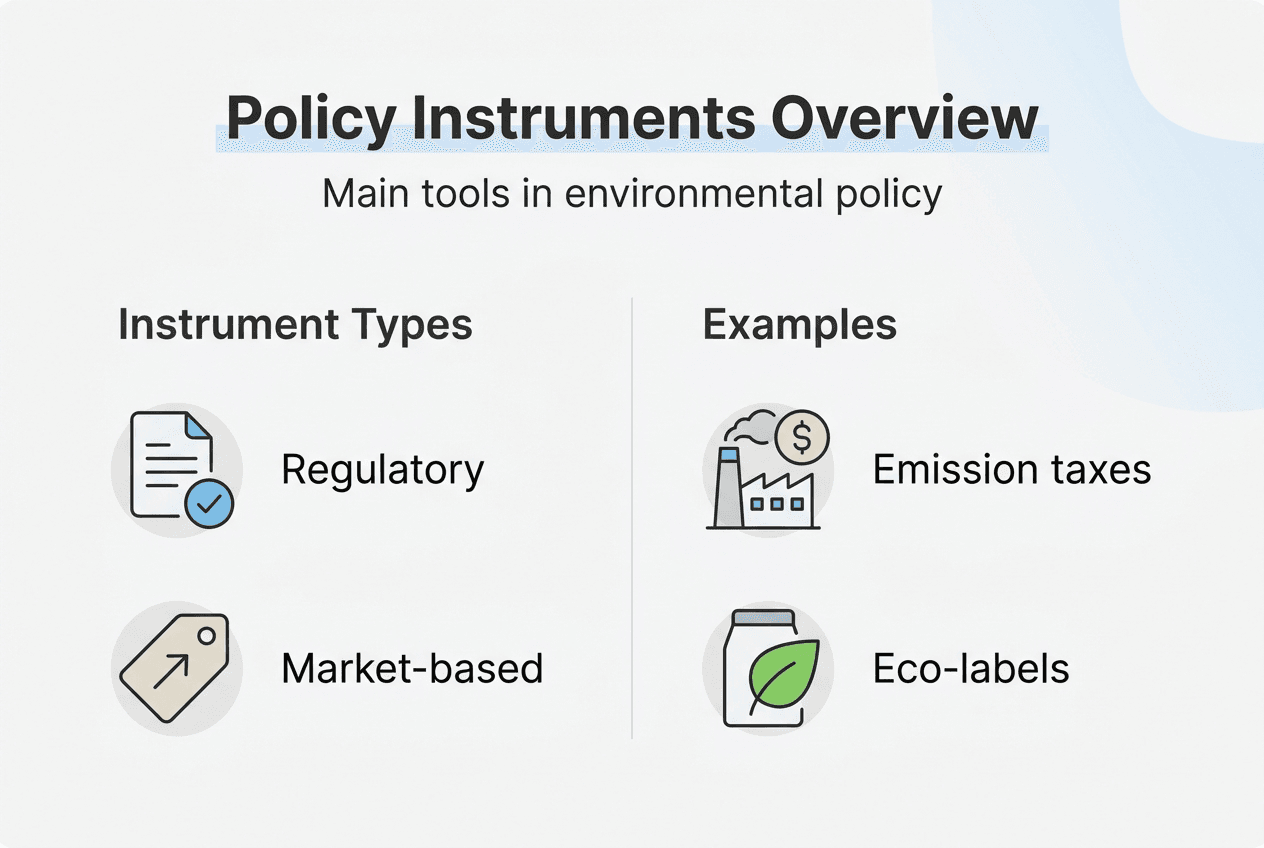
Market-based instruments use economic incentives to change behavior. Carbon taxes make polluting more expensive, encouraging businesses to reduce emissions. Cap-and-trade systems set overall pollution limits and allow companies to buy and sell emission permits, creating financial rewards for efficiency. Subsidies for renewable energy lower costs and accelerate adoption. These tools are often more efficient than pure regulation because they let businesses choose the cheapest way to comply. The concept of bounded rationality explains why policymakers may prefer cap-and-trade over taxes, as it sets a clear environmental outcome while allowing flexibility in how to achieve it.
Voluntary measures rely on cooperation rather than force. Eco-labeling programs help consumers choose sustainable products. Industry agreements commit companies to environmental targets beyond legal requirements. Educational campaigns build public support for conservation. While these approaches avoid regulatory costs and political resistance, they depend on goodwill and may not achieve sufficient change when economic pressures conflict with environmental goals.
Rights-based approaches recognize legal standing for ecosystems or communities. Some countries grant rivers or forests legal personhood, allowing lawsuits on their behalf. Indigenous land rights protect traditional territories and biodiversity. These instruments address justice and long-term stewardship but can face implementation challenges in legal systems designed around human property rights.
| Instrument Type | Key Features | Strengths | Weaknesses | Example |
|---|---|---|---|---|
| Regulatory | Mandatory standards and prohibitions | Clear rules, direct control, rapid action | Inflexible, high enforcement costs, limited innovation | Emission limits, EIA requirements |
| Market-based | Economic incentives and pricing | Cost-effective, encourages innovation, flexibility | May not ensure outcomes, equity concerns | Carbon tax, cap-and-trade, renewable subsidies |
| Voluntary | Cooperation and information | Low political resistance, builds support | Depends on goodwill, may be insufficient | Eco-labels, industry agreements |
| Rights-based | Legal standing for nature or communities | Addresses justice, long-term stewardship | Implementation challenges, legal conflicts | Rights of nature laws, indigenous land rights |
Exploring environmental policy tools used in data collection and analysis can deepen your understanding of how these instruments are monitored and evaluated in practice.
Pro Tip: In IB ESS assessments, always explain why a particular policy instrument was chosen for a specific environmental problem, considering factors like urgency, cost, political feasibility, and cultural context.
How environmental policies develop: the policy cycle explained
Environmental policies don’t appear overnight. They emerge through a structured process that helps governments identify problems, design solutions, and improve outcomes over time. Policy development follows a cycle of agenda setting, formulation, decision/adoption, implementation, evaluation/monitoring, and iteration. Understanding this cycle will help you structure ESS essays and analyze policy case studies with greater depth.
Agenda setting and problem identification: Environmental issues must first gain attention from policymakers and the public. Scientific research, media coverage, advocacy campaigns, or crises like oil spills can push problems onto the political agenda. For example, evidence of ozone layer depletion in the 1980s prompted international concern that led to the Montreal Protocol.
Policy formulation: Once an issue is recognized, experts and stakeholders analyze options. This stage involves cost-benefit analysis (CBA) to compare economic impacts, risk assessments to evaluate potential harms, and consultation with scientists, businesses, and communities. Formulation generates alternative approaches, from strict bans to market incentives, each with different trade-offs.
Decision and adoption: Political leaders and legislative bodies choose which policy to pursue. This step involves negotiation, compromise, and voting. Decisions reflect not only scientific evidence but also political pressures, economic interests, and public opinion. A policy may be weakened or strengthened during this phase depending on lobbying and coalition-building.
Implementation: Adopted policies must be put into practice through regulations, funding, and institutional arrangements. Agencies develop detailed rules, issue permits, conduct inspections, and enforce penalties. Implementation often reveals practical challenges like insufficient resources, bureaucratic delays, or resistance from regulated industries.
Evaluation and monitoring: Governments track whether policies achieve their goals by measuring pollution levels, biodiversity indicators, or compliance rates. Evaluation identifies successes, failures, and unintended consequences. For instance, monitoring might show that an emission standard reduced air pollution but imposed excessive costs on small businesses.
Iteration and revision: Based on evaluation findings, policies are adjusted, strengthened, or replaced. This feedback loop allows continuous improvement. Successful policies are expanded, while ineffective ones are reformed or abandoned. Iteration ensures policies remain relevant as science advances and conditions change.
Real-world policy cycles face disruptions. Political changes can halt promising initiatives. Implementation gaps occur when agencies lack capacity or political will. Stakeholder conflicts delay decisions. Despite these challenges, the cycle framework provides a useful lens for analyzing how environmental policies evolve.
Applying the environmental policy cycle approach in your IB ESS work helps you systematically evaluate case studies and propose improvements based on which stage needs strengthening.
Pro Tip: When writing about policy case studies, organize your analysis around the cycle stages to demonstrate comprehensive understanding and identify where breakdowns occurred or successes emerged.
Real-world impacts and complexities of environmental policies
Empirical evidence reveals both the power and complexity of environmental policies in practice. Stricter policies yield reductions in global warming potential by 10-27%, aquatic toxicity by 27%, and major programs saved hundreds of thousands of lives by cutting pollution. These numbers demonstrate that well-designed policies deliver measurable benefits for ecosystems and human health.
China’s Air Pollution Prevention and Control Action Plan (APPCAP) provides a compelling case study. Implemented in 2013, this comprehensive policy combined emission standards, coal restrictions, and industrial upgrades. Within five years, particulate matter concentrations dropped significantly in major cities, preventing an estimated 400,000 premature deaths. The program’s success came from coordinated action across multiple instruments and strong political commitment.
China’s environmental protection tax, introduced in 2018, shifted the burden from volume-based fees to pollution-based charges. This market mechanism encouraged companies to invest in cleaner technologies. Studies show it reduced emissions more effectively than the previous fee system because it created stronger financial incentives tied directly to environmental impact.
Yet policy effectiveness is rarely straightforward. Policy mixes cause synergies and conflicts that can amplify reductions in emissions from 10% to 22%. When carbon pricing combines with renewable energy subsidies and efficiency standards, the combined effect exceeds the sum of individual policies. However, poorly coordinated mixes can create conflicts, like subsidies that undermine price signals or regulations that overlap inefficiently.
| Policy Example | Pollution Reduction | Lives Saved | Key Mechanism |
|---|---|---|---|
| China APPCAP (2013-2018) | PM2.5 decreased 30-40% in major cities | ~400,000 premature deaths prevented | Multi-instrument regulatory and economic mix |
| US Clean Air Act Amendments (1990-2020) | SO2 emissions cut by 90% | ~230,000 lives saved annually by 2020 | Cap-and-trade for acid rain, technology standards |
| EU Emissions Trading System (2005-2025) | 35% reduction in covered sectors | Indirect health benefits via air quality | Market-based cap-and-trade mechanism |
Several challenges complicate policy success:
- Political resistance from industries facing costs or job losses can weaken or delay policies
- Implementation gaps between policy design and on-the-ground enforcement reduce effectiveness
- Equity concerns arise when policies burden low-income communities disproportionately
- Balancing economic growth with environmental protection creates trade-offs that require careful navigation
- Unintended consequences like carbon leakage, where industries relocate to countries with weaker rules, can undermine goals
Expert perspectives emphasize the need for nuance. As one environmental economist notes, “Effective environmental policy requires evidence-based design, coherent instrument mixes, adaptive management, and political commitment to navigate complex trade-offs between efficiency, equity, and environmental outcomes.”
Understanding how pollution and policy interactions play out in environmental systems helps you connect theoretical policy tools to real biosphere impacts in your IB ESS studies.
Get expert help mastering IB ESS environmental policy
Mastering environmental policy concepts is essential for excelling in IB Environmental Systems and Societies coursework, internal assessments, and exams. The complexity of policy instruments, cycles, and real-world applications requires deep understanding and analytical skills.
If you’re preparing for your internal assessment or need support with exam techniques, expert tutoring can make a significant difference. Our IB ESS internal assessment tutors provide personalized guidance tailored to your learning needs, helping you develop strong research questions, analyze data effectively, and write compelling reports. Access comprehensive IB ESS notes and textbooks to reinforce your understanding of policy frameworks and environmental systems. Prepare confidently for assessments with targeted IB ESS Paper 2 resources that sharpen your ability to analyze case studies and evaluate policy effectiveness under exam conditions.
Frequently asked questions
What is environmental policy in simple terms?
Environmental policy is the set of principles, rules, strategies, and actions governments and organizations use to protect ecosystems, control pollution, and manage natural resources sustainably. It balances environmental protection with economic and social needs through various tools like regulations, economic incentives, and voluntary programs.
How do environmental laws differ from environmental policies?
Environmental laws are legally binding statutes passed by legislatures that mandate specific actions or prohibit harmful activities, enforceable through courts and penalties. Environmental policies are broader frameworks that include laws but also encompass voluntary measures, economic instruments, educational programs, and strategic plans that guide environmental management without always requiring legal force.
Why are market-based tools like cap-and-trade often more efficient than taxes?
Cap-and-trade systems set a firm limit on total emissions and allow businesses to buy and sell permits, ensuring environmental outcomes while letting companies choose the cheapest compliance method. Taxes create financial disincentives but don’t guarantee specific pollution reductions. Cap-and-trade appeals to policymakers because it provides certainty about environmental goals while maintaining economic flexibility, addressing bounded rationality in decision making.
What are the main stages in the environmental policy cycle?
The six stages are agenda setting (identifying problems), formulation (analyzing options and conducting cost-benefit analysis), decision/adoption (choosing and approving policies), implementation (putting policies into practice), evaluation/monitoring (tracking effectiveness and impacts), and iteration (revising policies based on results). This cycle ensures continuous improvement and adaptation to changing conditions.
Why does policy effectiveness vary so much between countries?
Effectiveness depends on political commitment, institutional capacity, enforcement resources, stakeholder cooperation, and cultural context. Strong policies fail without adequate implementation, while well-enforced moderate policies can succeed. Policy mixes create synergies or conflicts that amplify or reduce impacts. Economic conditions, public support, and coordination across government levels also shape outcomes, making context crucial for success.
How do policy synergies improve environmental outcomes?
When multiple policy instruments work together coherently, they create synergies that amplify effectiveness beyond individual contributions. For example, combining carbon pricing with renewable subsidies and efficiency standards reinforces behavior change through multiple channels, reducing emissions more than any single tool alone. Understanding synergies helps you evaluate why comprehensive policy packages often outperform isolated measures in addressing complex environmental issues.
No Comments