


09 Apr Why models matter in IB ESS: your complete guide
TL;DR:
- Models simplify complex environmental systems to aid understanding and communication.
- They are essential for prediction, data analysis, and scenario testing in environmental science.
- Recognizing a model’s limitations fosters critical thinking and improves decision-making skills.
Many students assume that models in environmental science make things more complicated than they need to be. Actually, the opposite is true. Models simplify complex environmental systems, making them easier to analyze, understand, and communicate. If you are preparing for your IB ESS exams or working on your Internal Assessment, understanding how models work is one of the most practical skills you can develop. In this guide, we will break down what models are, why they matter, how to use them in your coursework, and how to discuss their limitations confidently in any exam question.
Table of Contents
- What are models in environmental science?
- Why use models? Simplification, prediction, and communication
- How are models used in IB ESS coursework and exams?
- Limitations and challenges of environmental models
- A fresh take: Beyond exam answers, what models teach us about thinking
- Take your IB ESS success further with the right resources
- Frequently asked questions
Key Takeaways
| Point | Details |
|---|---|
| Models simplify complexity | They help break down complex systems so you can understand and explain them clearly. |
| Essential for predictions | Models let you forecast environmental changes without risky real-world experiments. |
| Critical for IB success | Using and critiquing models is a core exam and Internal Assessment skill in IB ESS. |
| Know their limits | All models have drawbacks; explain them for higher marks. |
| Transferable thinking tool | Model-based thinking boosts flexible, critical, and creative problem-solving. |
What are models in environmental science?
In everyday language, a “model” might mean a miniature replica of something. In environmental science, the meaning is broader. A model is any simplified representation of a system that helps us understand how that system works, how its parts interact, and how it might respond to change.
Physical, conceptual, and mathematical models each simplify interactions for holistic views of environmental systems. These three types are the ones you need to know for IB ESS, and each one serves a different purpose.
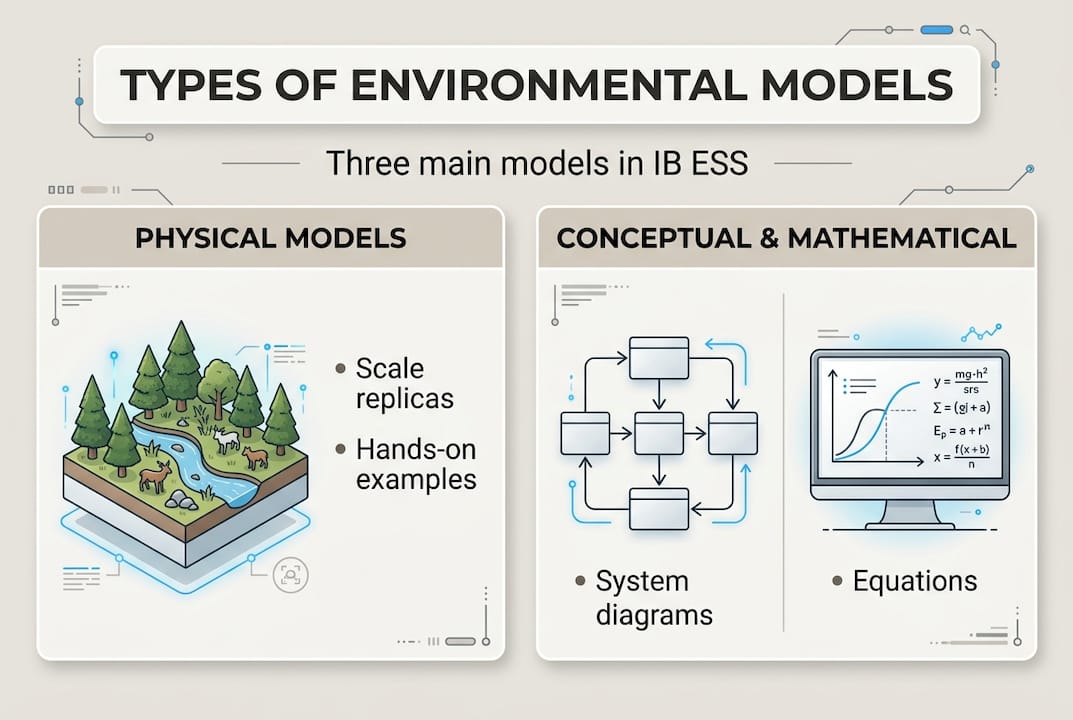
| Model type | Definition | Example | Strength | Limitation |
|---|---|---|---|---|
| Physical | A tangible, scaled-down version of a real system | A laboratory watershed or terrarium | Easy to observe directly | Cannot replicate full system complexity |
| Conceptual | A diagram or framework showing relationships between components | A food web or systems diagram | Communicates structure clearly | Does not produce quantitative outputs |
| Mathematical/Computational | Uses equations or software to simulate system behavior | A climate simulation model | Handles large, complex datasets | Requires high-quality data and computing power |
Here is a quick summary of common uses for each type:
- Physical models are useful for lab-based investigations and visual demonstrations.
- Conceptual models help you map out system relationships, especially in essay answers and diagrams.
- Mathematical models are used for predictions, scenario testing, and large-scale environmental analysis.
Understanding the types of environmental studies that rely on each model type will also help you connect this knowledge to broader ESS topics.
Pro Tip: In an exam question, match the model type to the complexity of the scenario. A simple ecosystem question might call for a conceptual model, while a climate question typically involves mathematical modeling. Naming the correct type and explaining why shows the examiner you really understand the concept.
Why use models? Simplification, prediction, and communication
Now that you know what models are, let us see why they are so essential, both scientifically and for your studies.
Environmental systems are incredibly complex. Think about a coral reef: it involves water temperature, pH, sunlight, hundreds of species, nutrient cycles, and human pressures all at once. No single study can capture all of that simultaneously. Models let scientists, and you as an IB student, focus on the most important variables without losing sight of the bigger picture.
The predictive power of models is especially relevant in climate science. Models enable predictions of system responses to changes without real-world experimentation, and are used in weather forecasts and climate scenarios predicting a 1.5 to 4 degrees Celsius rise by 2100. That range matters because it shapes global policy decisions. Understanding climate change impacts becomes much clearer when you can see how models generate those projections.
“Environmental models are not just scientific tools. They are communication devices that translate raw data into decisions that affect millions of people.”
Here are three specific ways models benefit your IB coursework:
- Simplifying data interpretation. Models help you identify patterns in complex datasets, which is directly useful when analyzing results in your Internal Assessment. Using the right tools for data analysis alongside model frameworks strengthens your IA methodology section.
- Supporting predictions and hypotheses. When you write a hypothesis, you are essentially building a simple model of expected outcomes. Referencing established models adds scientific credibility to your reasoning.
- Communicating findings clearly. A well-chosen diagram or conceptual model in an exam answer shows the examiner that you can organize and present information effectively, which earns marks across multiple assessment objectives.
The broader context of climate change effects on ecosystems is a great area to practice applying model thinking, since it involves multiple interacting variables that models help untangle.
How are models used in IB ESS coursework and exams?
With the core benefits of models clear, here is how they show up directly in IB coursework and exams.
In Paper 2, you will often encounter scenario-based questions where you need to explain system behavior, predict outcomes, or evaluate the impact of a change. Models give you the vocabulary and the framework to answer these questions precisely. In your Internal Assessment, models can support your hypothesis, justify your methodology, and help you interpret your results.

Models support hypothesis testing, scenario manipulation, and warning of future issues, with inputs changed to observe outputs instantly. That is exactly what happens in a well-structured IA: you change one variable and observe the effect, which mirrors how computational models operate.
Here are the key tasks in IB ESS where model knowledge directly helps you:
- Explain how a system works by referencing its components and flows (conceptual models are perfect here).
- Predict what will happen if a variable changes, using model logic to support your answer.
- Manipulate scenarios by adjusting inputs and describing expected outputs.
- Critique a model by identifying its assumptions and limitations.
- Justify your choice of model in an IA or extended response question.
Looking at learning approaches in ESS and ESS learning strategies can help you see how model thinking fits into the wider IB ESS skill set.
Pro Tip: Always acknowledge a model’s limitations in your exam answers. Examiners reward critical thinking. A sentence like “this model oversimplifies nutrient cycling by excluding decomposer activity” shows analytical depth and can push your answer from a 5 to a 7.
When you reference models in your answers, be specific. Name the model type, describe what it shows, and connect it to the question’s context. Vague references to “models” without explanation will not earn full marks. Specificity is everything in IB ESS. You can also look at environmental studies types to see how different fields use different modeling approaches.
Limitations and challenges of environmental models
However, models are not perfect. Let us look critically at their limitations.
Every model is built on assumptions. Those assumptions make the model manageable, but they also introduce error. Limitations include oversimplification, data quality dependence, uncertainty in long-term predictions, and varying outputs from the same inputs. Knowing these limitations is not just useful for exam answers. It is essential for understanding why environmental policy is sometimes controversial.
Here are the main limitations you should be able to discuss:
- Oversimplification. Models reduce complex systems to manageable variables, but important interactions can be left out.
- Data quality dependence. A model is only as good as the data fed into it. Gaps or errors in data lead to unreliable outputs.
- Assumption risks. Every model assumes certain conditions remain constant. When those conditions change unexpectedly, model predictions can be wrong.
- Uncertainty in long-term predictions. The further into the future a model projects, the wider the range of possible outcomes.
- Varying outputs. Different research teams using similar inputs can produce different results, which creates uncertainty in policy decisions.
Hindcasting tests accuracy; models predict ranges due to imperfect data. Hindcasting means running a model using historical data to see if it correctly reproduces past conditions. If it does, scientists gain more confidence in its future projections. If it does not, the model needs adjustment.
“All models are wrong, but some are useful.” This well-known idea in science captures something important: the goal is not perfection, but insight.
Real-world policy decisions, from carbon taxes to protected area designations, are made based on model outputs. That is why critiquing models responsibly matters. The intersection of AI and environment is also worth exploring, since artificial intelligence is now being used to improve model accuracy and reduce some of these limitations. You can also read more about ongoing climate model development to see how scientists are actively working to address these challenges.
A fresh take: Beyond exam answers, what models teach us about thinking
Here is something worth considering. Most students treat model limitations as a weakness to apologize for. I see it differently. Recognizing that a model oversimplifies is not a failure. It is the first step in thinking clearly about a problem.
Climate models evolve with computing and AI, but regional fidelity challenges persist, and hindcasting validates models even as assumptions introduce errors. That tension, between usefulness and imperfection, is exactly what critical thinking looks like in practice.
When you learn to choose a model, justify it, and then honestly critique it, you are practicing a skill that goes far beyond IB ESS. You are learning to structure problems, test ideas, and communicate uncertainty clearly. These are skills that matter in university, in careers, and in everyday decision-making.
“All models are approximations. Understanding their limits empowers you to use them wisely.”
I encourage you to practice justifying your model choices in open-ended questions. Do not just name a model. Explain why it fits, what it reveals, and what it misses. That kind of answer stands out. Exploring ESS key concepts can help you connect model thinking to the broader themes of the course.
Pro Tip: In open-ended exam questions, practice writing one sentence that justifies your model choice and one sentence that acknowledges its main limitation. This two-sentence habit can significantly improve your marks on analytical questions.
Take your IB ESS success further with the right resources
Understanding models is one of those topics that pays off across the entire IB ESS course. Strong model knowledge improves your Paper 2 answers, strengthens your Internal Assessment, and builds the critical thinking skills examiners are looking for.
If you want personalized support to master models and every other ESS topic, working with a specialist tutor makes a real difference. You can get expert help with your IB ESS IA, access quality ESS notes and textbook resources, and get targeted ESS exam tips that are built around the actual assessment criteria. With over 13 years of IB experience, I am here to help you feel confident and prepared.
Frequently asked questions
How do environmental models help with IB ESS exams?
Models support hypothesis testing, scenario manipulation, and warning of future issues, giving you a clear framework to explain, predict, and critique system behavior, which are key skills for earning high marks in both Paper 1 and Paper 2.
What are the main types of models in environmental science?
Physical, conceptual, and mathematical models each simplify nature in different ways, from hands-on replicas to diagrams to computer simulations, and each serves a different purpose in study and communication.
Why are models imperfect or sometimes inaccurate?
Limitations include oversimplification and data quality dependence, meaning every model makes assumptions and relies on available data, so it cannot predict every outcome with complete accuracy.
How can I apply model thinking beyond environmental science?
Model thinking helps you structure problems, test ideas, and communicate uncertainty clearly in any field. As explored in recent climate model research, the habit of justifying choices and acknowledging limitations is a transferable skill that applies well beyond science.
No Comments